Chemistry › Carbonyls and carboxylic acids › Acylation: acyl chlorides and acid anhydrides
Acylation: acyl chlorides and acid anhydrides
Unstopper a bottle of ethanoyl chloride in damp air and it fumes: the liquid is reacting with the water vapour and releasing hydrogen chloride. Acyl chlorides and acid anhydrides transfer their acyl group to water, alcohols, ammonia and amines by nucleophilic addition followed by elimination, and the same reaction, run with the anhydride, makes aspirin.
Key terms Every definition in carbonyls and carboxylic acids, lesson by lesson
Before this Aldehydes and ketones: nucleophilic addition and the tests that tell them apart – nucleophilic addition to a polar C=O bond and how its curly arrows are drawn · Carboxylic acids, esters and biodiesel – esterification is slow and reversible · Halogenoalkanes: nucleophilic substitution and rates of hydrolysis – the halide ion as a leaving group
COMMON MISCONCEPTION
An acyl chloride reacts like a chloroalkane, so the nucleophile simply pushes the chlorine off in one step.
The nucleophile attacks the carbonyl carbon and the C=O π bond breaks first, giving a tetrahedral intermediate that still holds the chlorine. The C=O then re-forms and pushes Cl⁻ out, and a proton is lost: nucleophilic addition–elimination. A chloroalkane has no C=O to open, so its substitution is a single step.
What you should be able to do
- Name acyl chlorides, acid anhydrides, amides and N-substituted amides from their formulae.
- Write equations for the reactions of acyl chlorides and acid anhydrides with water, alcohols, ammonia and primary amines, and state the observations.
- Outline the nucleophilic addition–elimination mechanism for an acyl chloride with water, an alcohol, ammonia or a primary amine.
- Explain why acyl chlorides react faster than carboxylic acids.
- Evaluate the use of ethanoic anhydride rather than ethanoyl chloride in the manufacture of aspirin.
- Write equations for making an acyl chloride from a carboxylic acid with SOCl₂ or PCl₅.CAIE · Edexcel · OCR A
The acyl group and the reagents that carry it
An acyl group is RCO–, the part of a carboxylic acid left when the OH is removed. Ethanoic acid's acyl group is CH₃CO–, the ethanoyl group. Replace the acid's OH with Cl and the result is an acyl chloride: ethanoyl chloride, CH₃COCl, a colourless liquid that boils at 51 °C. Join two acyl groups through one oxygen and the result is an acid anhydride: ethanoic anhydride, (CH₃CO)₂O, made in effect by removing one water molecule from two ethanoic acid molecules.
Both compounds transfer their acyl group to a nucleophile, a process called acylation. The nucleophile must have a lone pair on an O or N atom carrying a hydrogen, and the hydrogen ends up in the small molecule given off: HCl from an acyl chloride, a carboxylic acid from an anhydride.
Acyl chlorides react far faster than carboxylic acids. The carbonyl carbon of an acyl chloride is bonded to two electronegative atoms, O and Cl, both pulling electron density away from it, so it carries a larger δ+ charge and attracts nucleophiles more strongly. The chloride ion is also a good leaving group, much better than the hydroxide ion an acid would have to lose. The reactions happen at room temperature, go to completion, and need no catalyst. Compare that with esterification from the acid, which needs heat and a concentrated sulfuric acid catalyst and stops at equilibrium.
Names follow the parent acid. Replace -oic acid with -oyl chloride for the acyl chloride, so propanoic acid gives propanoyl chloride, CH₃CH₂COCl, and benzoic acid gives benzoyl chloride, C₆H₅COCl. Replace acid with anhydride for the anhydride: ethanoic anhydride. Replace -oic acid with -amide for the amide: ethanamide, propanamide. Any group on the nitrogen of an amide is written in front with N-, as in N-methylpropanamide.
The speed has a practical cost. Acyl chlorides react with the water vapour in air, so they are stored in tightly sealed bottles, measured out quickly in a fume cupboard, and kept away from skin and eyes, where they react with moisture and release hydrochloric acid. They are lachrymators: the vapour makes the eyes stream.
- Acyl chloride
- A compound containing the functional group –COCl, in which the OH of a carboxylic acid is replaced by a chlorine atom.
- Acid anhydride
- A compound with two acyl groups joined through one oxygen atom, (RCO)₂O.
- Acylation
- The substitution of an acyl group, RCO–, for a hydrogen atom on an O or N atom of a nucleophile.
- Acyl group
- The RCO– group: a carbonyl carbon bonded to an alkyl or aryl group, left when the OH is removed from a carboxylic acid.
- Leaving group
- An atom or group that departs with the bonding pair of electrons when its bond breaks, such as Cl⁻ from an acyl chloride.
Four nucleophiles, four products
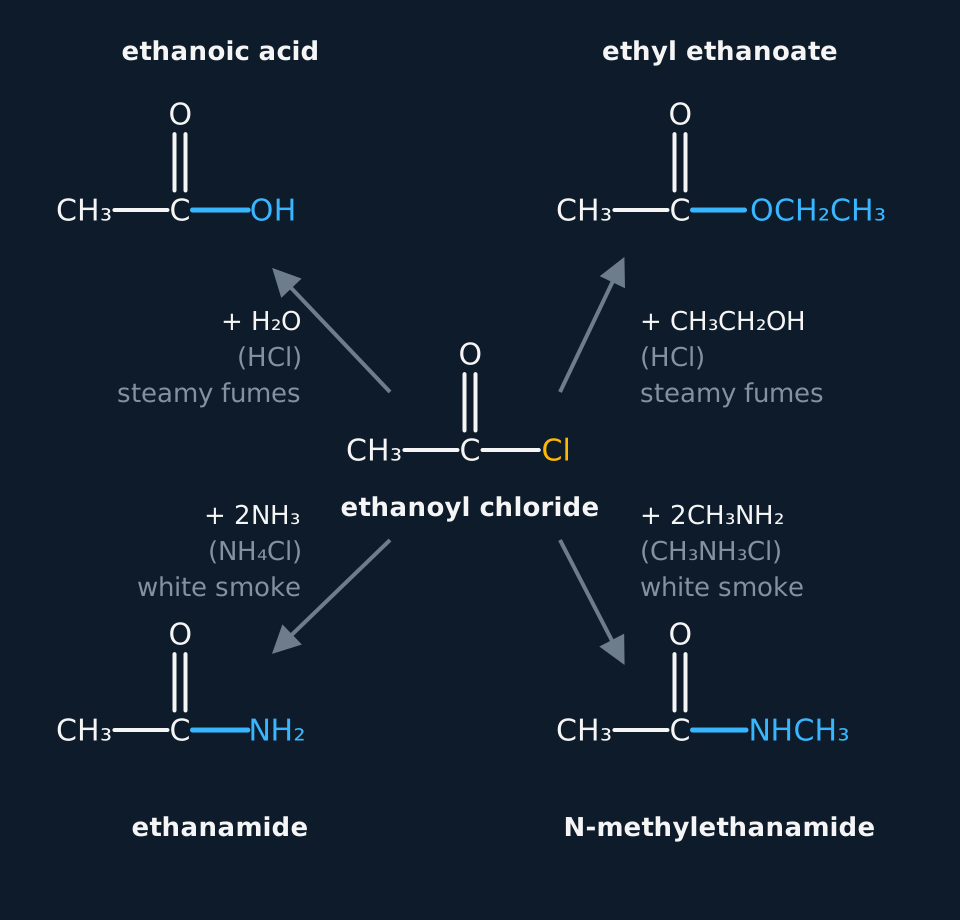
Ethanoyl chloride reacts with each of four nucleophiles, water, alcohols, ammonia and primary amines, and each reaction releases hydrogen chloride. With water the reaction is violent, the liquid hisses and steamy white fumes of HCl appear. The product is ethanoic acid.
CH₃COCl(l) + H₂O(l) → CH₃COOH(aq) + HCl(g)
The difference from a chloroalkane shows in a test tube. Add a few drops of ethanoyl chloride to aqueous silver nitrate and a white precipitate of silver chloride forms at once, because the chloride ion is released in seconds. 1-Chlorobutane in the same test gives a faint precipitate only after warming for several minutes, since its C–Cl bond is broken by water far more slowly.
With an alcohol, the product is an ester. Unlike esterification from the acid, this is fast and not reversible, so the yield is much higher. Ethanol gives ethyl ethanoate and steamy fumes of HCl.
CH₃COCl(l) + CH₃CH₂OH(l) → CH₃COOCH₂CH₃(l) + HCl(g)
With ammonia, the product is an amide, ethanamide, CH₃CONH₂. Ammonia is a base, so a second ammonia molecule reacts with the HCl formed and the by-product is ammonium chloride, seen as white smoke or a white solid. The equation therefore uses two NH₃.
CH₃COCl(l) + 2NH₃(aq) → CH₃CONH₂(s) + NH₄Cl(s)
With a primary amine such as methylamine, the product is an N-substituted amide, N-methylethanamide, CH₃CONHCH₃. The N in the name shows that the methyl group is on the nitrogen, not the carbon chain. Again a second molecule of the amine takes up the HCl, as methylammonium chloride.
CH₃COCl(l) + 2CH₃NH₂(aq) → CH₃CONHCH₃(aq) + CH₃NH₃Cl(aq)
Describe the drawing
Ethanoyl chloride, CH₃COCl with its C=O displayed, sits at the centre with four arrows running out to four products. With water, losing HCl as steamy fumes, it gives ethanoic acid; with ethanol, losing HCl, ethyl ethanoate; with two moles of ammonia, forming ammonium chloride as white smoke, ethanamide; with two moles of methylamine, forming methylammonium chloride, N-methylethanamide. In each product the CH₃–C=O is unchanged and the group that replaced chlorine, OH, OCH₂CH₃, NH₂ or NHCH₃, is highlighted.
An acid anhydride gives the same four organic products more slowly, usually with warming, and its by-product is a carboxylic acid rather than HCl. With ethanol, ethanoic anhydride gives ethyl ethanoate and ethanoic acid.
(CH₃CO)₂O(l) + CH₃CH₂OH(l) → CH₃COOCH₂CH₃(l) + CH₃COOH(l)
| Nucleophile | Product with ethanoyl chloride | Product with ethanoic anhydride | Observation |
|---|---|---|---|
| water | ethanoic acid + HCl | ethanoic acid only | chloride: violent, steamy fumes |
| ethanol | ethyl ethanoate + HCl | ethyl ethanoate + ethanoic acid | chloride: steamy fumes |
| ammonia | ethanamide + NH₄Cl | ethanamide + ammonium ethanoate | white smoke or solid |
| methylamine | N-methylethanamide + CH₃NH₃Cl | N-methylethanamide + methylammonium ethanoate | white smoke or solid |
With ammonia or an amine, the by-product from the anhydride is a salt as well: the ethanoic acid released reacts with a second molecule of the base. The organic product named in an answer is the amide in every case, and naming the salt instead does not answer a question that asks for the organic product.
- Amide
- A compound containing the group –CONH₂, formed when an acyl chloride or anhydride reacts with ammonia.
- N-substituted amide
- An amide in which one or both hydrogens on the nitrogen are replaced by alkyl groups, formed from a primary or secondary amine.
Nucleophilic addition–elimination
The mechanism has two stages, and the name says what they are. First a nucleophile adds to the C=O carbon, just as in an aldehyde, and the π electrons move onto the oxygen. Then the C=O bond reforms and a chloride ion is eliminated. A halogenoalkane is attacked in one step because its carbon has no π bond to open; the acyl chloride's carbon has one, so the nucleophile adds first and the chloride leaves afterwards.
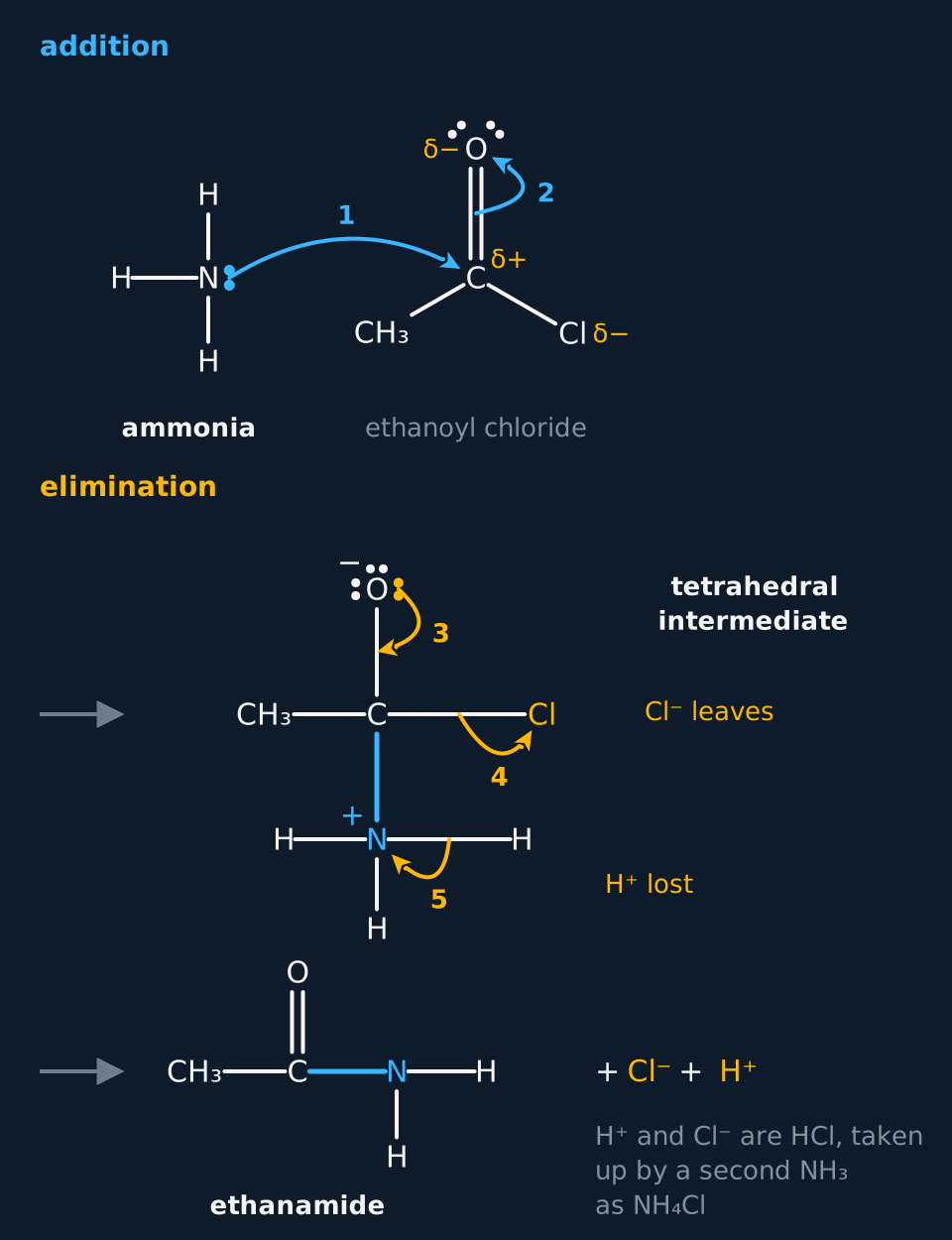
With ammonia the arrows are these. Arrow 1 starts on the lone pair of the nitrogen in NH₃ and ends on the δ+ carbonyl carbon. Arrow 2 starts on the C=O double bond and ends on the oxygen. The intermediate has a tetrahedral carbon bonded to CH₃, Cl, an O⁻ with three lone pairs, and an NH₃ group whose nitrogen now carries a positive charge, since it has shared its lone pair.
In the elimination stage, arrow 3 starts on a lone pair of the O⁻ and ends on the C–O bond, reforming C=O. At the same time arrow 4 starts on the C–Cl bond and ends on the chlorine, which leaves as Cl⁻. Finally arrow 5 starts on one N–H bond and ends on the N⁺, and the hydrogen is lost as H⁺, picked up by Cl⁻ or by a second ammonia molecule. The product is ethanamide.
Describe the drawing
A three-row mechanism. In the addition row, ammonia with a lone pair on nitrogen faces ethanoyl chloride, whose carbonyl carbon is δ+ and whose oxygen and chlorine are δ−. Arrow 1 runs from the nitrogen lone pair to the carbonyl carbon; arrow 2 from the C=O bond onto oxygen. In the elimination row the tetrahedral intermediate has O⁻ with three lone pairs and ⁺NH₃: arrow 3 runs from an oxygen lone pair back to the C–O bond to reform C=O, arrow 4 from the C–Cl bond onto chlorine, which leaves as Cl⁻, and arrow 5 from an N–H bond onto N⁺, losing H⁺. The products are ethanamide, Cl⁻ and H⁺, which a second ammonia takes up as ammonium chloride.
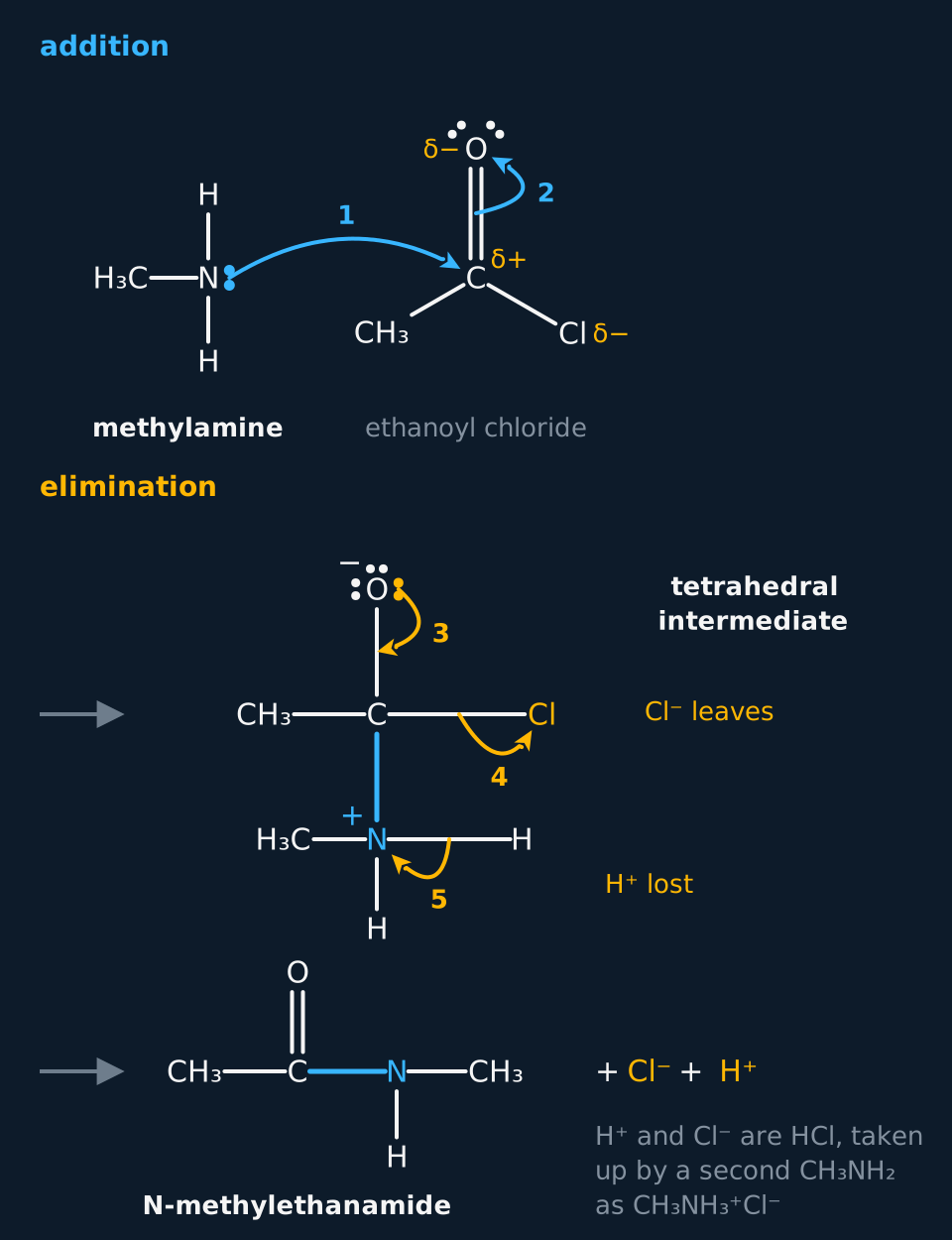
With water or an alcohol the arrows are identical, starting from a lone pair on the oxygen of H₂O or of CH₃CH₂OH. The intermediate then has a positive charge on that oxygen, and the last arrow starts on its O–H bond. With methylamine they start from the lone pair on the nitrogen of CH₃NH₂, and the intermediate carries CH₃NH₂⁺ on the carbon.
An acid anhydride reacts by the same mechanism. The nucleophile adds to one of the two carbonyl carbons, and in the elimination step the leaving group is a carboxylate ion, CH₃COO⁻, in place of Cl⁻. The carboxylate ion is a poorer leaving group than chloride, and the anhydride's carbonyl carbon is less δ+, which is why anhydrides react more slowly and often need warming.
Describe the drawing
The same three-row mechanism as for ammonia, with methylamine as the nucleophile. Arrow 1 runs from the lone pair on the nitrogen of CH₃NH₂ to the δ+ carbonyl carbon of ethanoyl chloride and arrow 2 from the C=O bond onto oxygen. The tetrahedral intermediate carries O⁻ and ⁺NH₂CH₃; arrow 3 reforms C=O from an oxygen lone pair, arrow 4 sends the C–Cl pair onto chlorine, and arrow 5 sends an N–H pair onto N⁺. The products are N-methylethanamide, Cl⁻ and H⁺, the HCl taken up by a second methylamine as methylammonium chloride.
Outlining the mechanism for ethanoyl chloride and water
Outline the mechanism for the reaction of ethanoyl chloride with water, and name the type of mechanism.
Show the working
Draw ethanoyl chloride displayed at the carbonyl carbon, with δ+ on C, δ− on O and δ− on Cl. Draw H₂O with one lone pair on its oxygen.
Addition: an arrow from the lone pair on the water oxygen to the carbonyl carbon, and an arrow from the C=O bond to the carbonyl oxygen.
Draw the intermediate: carbon bonded to CH₃, Cl, O⁻ and an OH₂⁺ group, with the charges shown.
Elimination: an arrow from a lone pair on O⁻ to the C–O bond, an arrow from the C–Cl bond to Cl, and an arrow from an O–H bond of the OH₂⁺ to its oxygen. Cl⁻ and H⁺ leave as HCl, and ethanoic acid remains. The mechanism is nucleophilic addition–elimination.
- Nucleophilic addition–elimination
- A mechanism in which a nucleophile adds to the carbonyl carbon of an acyl compound and a small molecule such as HCl is then eliminated, reforming the C=O bond.
Aspirin: why industry uses the anhydride
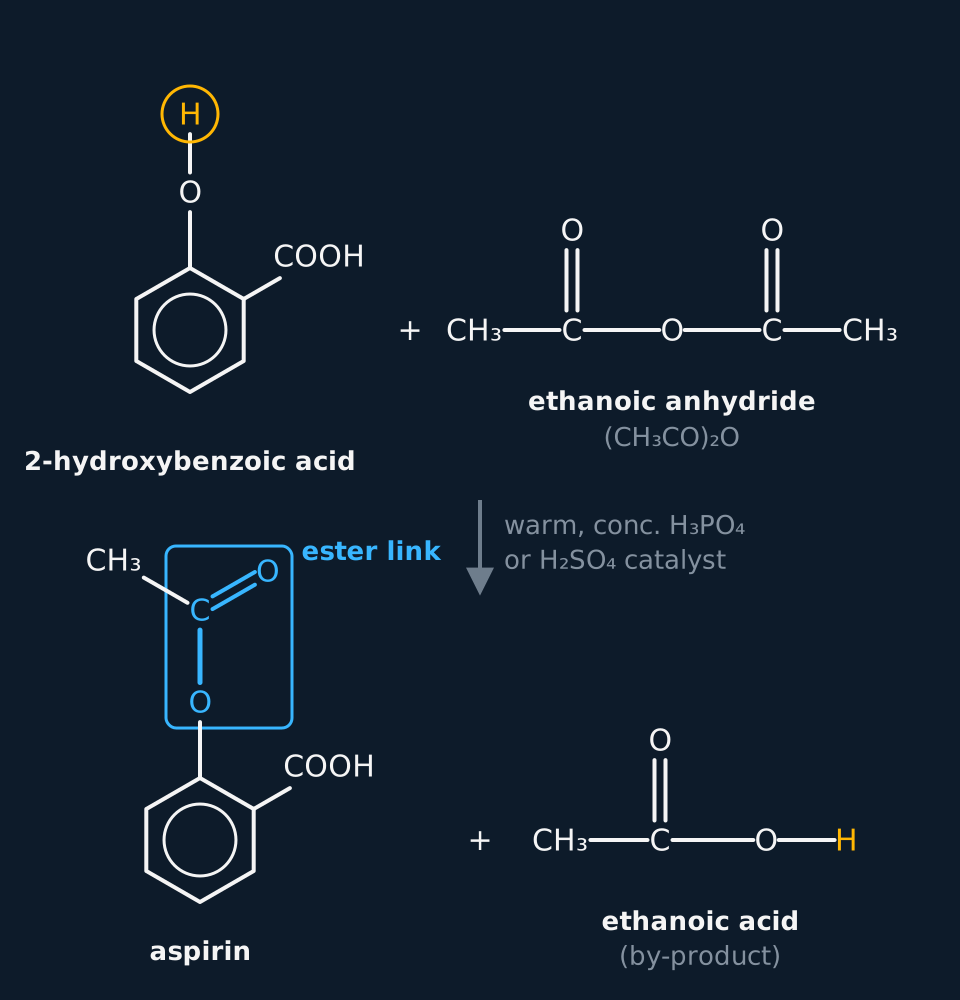
Aspirin is made by acylating the OH group of 2-hydroxybenzoic acid, the phenol group on the benzene ring. In school the reagent is ethanoic anhydride, warmed with the acid and a few drops of concentrated sulfuric or phosphoric acid as a catalyst, and the crude aspirin is then recrystallised from hot water or ethanol. Industry uses the same reagent. Phenols react only very slowly with carboxylic acids, so a phenol ester such as aspirin cannot be made by ordinary esterification; an acylating agent is needed.
The purity of the crystals is checked by melting point. Pure aspirin melts sharply at 135 °C. Unreacted 2-hydroxybenzoic acid, or water left from recrystallisation, lowers the melting point and spreads it over several degrees. Adding iron(III) chloride solution also shows unreacted starting material, since the free phenol group gives a purple colour and aspirin does not.
HOC₆H₄COOH(s) + (CH₃CO)₂O(l) → CH₃COOC₆H₄COOH(s) + CH₃COOH(l)2-hydroxybenzoic acid + ethanoic anhydride → aspirin + ethanoic acid
Describe the drawing
2-Hydroxybenzoic acid, drawn as a benzene ring with a delocalised circle, carries an OH on one ring carbon, its hydrogen circled, and a COOH on the next carbon. It reacts with ethanoic anhydride, CH₃CO–O–COCH₃, when warmed with concentrated phosphoric or sulfuric acid as catalyst. The products are aspirin, the same ring with COOH unchanged and the OH replaced by O–C(=O)–CH₃, the new ester link boxed, and ethanoic acid, which has taken the circled hydrogen.
Ethanoyl chloride would give aspirin too, and the anhydride is chosen for practical reasons. It is cheaper to make in bulk. It is less corrosive and reacts less violently, so the reaction is easier to control on a large scale. It reacts only slowly with water vapour in the air, so it is safer to store and handle. Its by-product is ethanoic acid, which is far less hazardous than hydrogen chloride gas and can be recovered and sold or used again.
Comparing atom economies for aspirin
Calculate the atom economy for making aspirin, Mr 180.0, from 2-hydroxybenzoic acid, Mr 138.0, with ethanoic anhydride, Mr 102.0, and with ethanoyl chloride, Mr 78.5. Comment on the result.
Show the working
Anhydride: total mass of reactants = 138.0 + 102.0 = 240.0. Atom economy = 180.0 ÷ 240.0 × 100 = 75.0%.
Acyl chloride: total mass of reactants = 138.0 + 78.5 = 216.5. Atom economy = 180.0 ÷ 216.5 × 100 = 83.1%.
The acyl chloride route has the higher atom economy, so atom economy alone does not explain the choice. The anhydride's by-product, ethanoic acid, is useful and easily recovered, which offsets the lower figure, and the anhydride is cheaper and safer to handle. Cost and safety decide the route.
TRY IT: Propanoyl chloride and ethylamine
Propanoyl chloride, CH₃CH₂COCl, is added to an excess of ethylamine, CH₃CH₂NH₂. Write an equation for the reaction and name the organic product.
Check your answer
Ethylamine is a primary amine, so the product is an N-substituted amide, and a second molecule of ethylamine takes up the HCl: CH₃CH₂COCl + 2CH₃CH₂NH₂ → CH₃CH₂CONHCH₂CH₃ + CH₃CH₂NH₃Cl.
The amide is named from the acyl group, propanamide, with the ethyl group on nitrogen shown by N: N-ethylpropanamide.
Other boards: making acyl chlorides, aryl chlorides and amides
Acyl chlorides are made from carboxylic acids by replacing the OH with Cl. AQA starts from the acyl chloride and does not ask how it is made. OCR names sulfur dichloride oxide, SOCl₂, also called thionyl chloride; Edexcel names phosphorus(V) chloride, PCl₅; Cambridge accepts either, or phosphorus(III) chloride, PCl₃. Each reaction is done dry and in a fume cupboard, since water would hydrolyse the product as fast as it forms.
CH₃COOH(l) + SOCl₂(l) → CH₃COCl(l) + SO₂(g) + HCl(g)
CH₃COOH(l) + PCl₅(s) → CH₃COCl(l) + POCl₃(l) + HCl(g)
3CH₃COOH(l) + PCl₃(l) → 3CH₃COCl(l) + H₃PO₃(s)
SOCl₂ is often preferred because both of its by-products are gases that leave the flask, so the acyl chloride is left behind and needs little separating. With PCl₅ the by-product POCl₃ is a liquid that boils at 106 °C, and the ethanoyl chloride, boiling at 51 °C, is separated from it by fractional distillation. The steamy fumes of HCl given off when solid PCl₅ is added to a dry liquid are also a test for an –OH group, in alcohols and acids alike.
In the silver nitrate test, chlorobenzene, C₆H₅Cl, gives no precipitate even on boiling. One lone pair on its chlorine overlaps with the ring's delocalised π electrons, which strengthens the C–Cl bond, and the electron-rich ring repels an approaching nucleophile. Cambridge asks for this order: acyl chloride, then alkyl chloride, then aryl chloride.
| Ethanoyl chloride | 1-Chlorobutane | Chlorobenzene | |
|---|---|---|---|
| With water | Violent, at room temperature | Very slow, needs warming | No reaction, even on boiling |
| With AgNO₃(aq) | White precipitate at once | Faint precipitate after minutes of warming | No precipitate |
| Reason | Carbon very δ+; nucleophile adds to C=O first | One δ+ carbon; C–Cl broken in substitution | C–Cl strengthened by overlap with the ring |
Cambridge also asks what happens to an amide afterwards. Heated under reflux with dilute acid, an amide is hydrolysed to the carboxylic acid and an ammonium salt. Heated with aqueous alkali, it gives the carboxylate salt and ammonia, which turns damp red litmus blue. LiAlH₄ in dry ether reduces an amide to an amine: propanamide gives propylamine.
CH₃CONH₂(s) + H₂O(l) + HCl(aq) → CH₃COOH(aq) + NH₄Cl(aq)
CH₃CONH₂(s) + NaOH(aq) → CH₃COONa(aq) + NH₃(g)
CH₃CH₂CONH₂(s) + 4[H] → CH₃CH₂CH₂NH₂(l) + H₂O(l)LiAlH₄ in dry ether
An amide has a lone pair on its nitrogen, as an amine does, but it is a far weaker base. The lone pair is delocalised into the neighbouring C=O group, so it is much less available to accept a proton. A solution of ethanamide is close to neutral, while a solution of methylamine is alkaline.
Aspirin is a phenyl ester, and OCR and Cambridge ask how phenol itself is esterified. Phenol reacts with an acyl chloride at room temperature, more slowly than ethanol, because a lone pair on its oxygen is partly delocalised into the ring and is less available to attack the carbonyl carbon. Cambridge's example is phenyl benzoate. Phenol is first dissolved in aqueous sodium hydroxide, giving the phenoxide ion, a far better nucleophile; benzoyl chloride is then shaken with the solution, and the ester separates as a white solid.
C₆H₅OH(s) + C₆H₅COCl(l) → C₆H₅COOC₆H₅(s) + HCl(g)Phenol and benzoyl chloride give phenyl benzoate
In the exam
- The intermediate earns its mark only with both charges shown: O⁻ on the former carbonyl oxygen and + on the nucleophile's N or O.
- The mechanism is named nucleophilic addition–elimination. The scheme does not accept 'nucleophilic substitution', which names the halogenoalkane mechanism.
- With ammonia or an amine, the equation is balanced with two molecules of the nitrogen compound and the ammonium salt as the second product, since the HCl cannot survive beside excess base.
- For the anhydride in making aspirin, the scheme credits any two of: cheaper, less corrosive, less violent, less readily hydrolysed by moisture, by-product not HCl. 'Safer' alone is too vague to score.
- Observations are steamy fumes for HCl and white smoke or white solid for NH₄Cl; 'gas given off' names no observation.
Check yourself
Ethyl ethanoate can be made from ethanoic acid or from ethanoyl chloride, each reacting with ethanol. Compare the two routes in terms of conditions, rate, yield and by-product.
Answer
From ethanoic acid the reaction needs heat and a concentrated sulfuric acid catalyst, is slow, and is reversible, so it reaches equilibrium with a yield of around two thirds. Its by-product is water.
From ethanoyl chloride the reaction is fast at room temperature with no catalyst, because the carbonyl carbon is more δ+ and Cl⁻ is a good leaving group. It is not reversible, so the yield is close to complete.
The acyl chloride route gives off hydrogen chloride, a toxic, corrosive gas, so it is done in a fume cupboard, and ethanoyl chloride itself is expensive and reacts violently with water.
Questions
Question 16 marksAQA
Evaluate the use of ethanoic anhydride rather than ethanoyl chloride for the industrial manufacture of aspirin from 2-hydroxybenzoic acid.
Mark scheme
Indicative content
- the acyl chloride route has the higher atom economy, because its by-product, HCl, is lighter than ethanoic acid, which on its own favours it
- ethanoic anhydride is cheaper to make in bulk, which matters more than atom economy at industrial scale
- the anhydride is less corrosive and reacts less violently, so the reaction is easier to control in a large vessel
- it is hydrolysed only slowly by water vapour in the air, so it is safer to store and handle than ethanoyl chloride
- its by-product, ethanoic acid, is far less hazardous than hydrogen chloride gas and can be recovered and sold or reused
- a justified conclusion: cost, safety and a useful by-product outweigh the lower atom economy, so the anhydride is the better choice
Levels
- Level 3 (5–6 marks) the higher atom economy of the acyl chloride route is acknowledged and outweighed by all the factors on the other side, cost, controllability, ease of storage and the safer, saleable by-product, with a justified conclusion in favour of the anhydride; the answer compares the two reagents throughout rather than describing one
- Level 2 (3–4 marks) two or three reasons for the anhydride are right and a conclusion is drawn; atom economy is left out, or the by-products are not set side by side
- Level 1 (1–2 marks) the anhydride is called safer or cheaper with no reason, or is preferred for a higher atom economy, which in fact belongs to the acyl chloride route
Question 25 marks
Outline the mechanism for the reaction of ethanoyl chloride with ethanol, and name the type of mechanism.
Mark scheme
- B1 curly arrow from a lone pair on the oxygen of ethanol to the carbonyl carbon
- B1 curly arrow from the C=O double bond to the oxygen atom
- B1 intermediate drawn with O⁻ and with a positive charge on the oxygen of the ethanol group
- B1 three arrows: from O⁻ back to reform C=O, from the C–Cl bond to Cl, and from the O–H bond to O⁺
- B1 the mechanism is nucleophilic addition–elimination
Question 34 marks
Name the compounds CH₃CH₂COCl and (CH₃CO)₂O, and name the organic products formed when ethanoyl chloride reacts with methanol and with ethylamine.
Mark scheme
- B1 CH₃CH₂COCl is propanoyl chloride
- B1 (CH₃CO)₂O is ethanoic anhydride
- B1 methanol gives methyl ethanoate, CH₃COOCH₃
- B1 ethylamine gives N-ethylethanamide, CH₃CONHCH₂CH₃; the N is required
All 19 questions with mark schemes, the other 16 set out in full on the question page.
Worth remembering
- An acyl chloride is not a chloroalkane: the nucleophile adds to C=O before Cl⁻ leaves.
- With ammonia or an amine, two molecules react: one as nucleophile, one to take up the HCl.
- The N- in N-methylethanamide puts the methyl group on nitrogen, not on the chain.
- The intermediate carries two charges: O⁻ and a + on the nucleophile's N or O.
- Atom economy favours the chloride for aspirin; cost and safety choose the anhydride.
CHECK YOUR PROGRESS
Rate how confident you are with each objective for this lesson. Ratings are saved in this browser, on this device, unless you sign in.
- Name acyl chlorides, acid anhydrides, amides and N-substituted amides from their formulae.
- Write equations for the reactions of acyl chlorides and acid anhydrides with water, alcohols, ammonia and primary amines, and state the observations.
- Outline the nucleophilic addition–elimination mechanism for an acyl chloride with water, an alcohol, ammonia or a primary amine.
- Explain why acyl chlorides react faster than carboxylic acids.
- Evaluate the use of ethanoic anhydride rather than ethanoyl chloride in the manufacture of aspirin.
- Write equations for making an acyl chloride from a carboxylic acid with SOCl₂ or PCl₅.CAIE · Edexcel · OCR A
Open the full revision checklist to see every objective in the curriculum in one place.
Practise this lesson
WORKBOOK
The written questions from this topic, on paper with room to work, and a separate book of mark schemes. The question that is set on a diagram stays on this page, where the diagram can be drawn. Free to use; please do not redistribute or sell.
Used later in Amines: preparation, basicity and nucleophilic reactions · Preparing, purifying and testing an organic solid and liquid