Chemistry › Carbonyls and carboxylic acids › Carboxylic acids, esters and biodiesel
Carboxylic acids, esters and biodiesel
Vinegar fizzes on washing soda, and the smell of pear drops comes from an ester made from that same acid. Carboxylic acids are weak acids that still react with carbonates, bases and reactive metals. With alcohols they form esters, and the esters called fats and oils are split by alkali into soap or swapped with methanol into biodiesel.
Key terms Every definition in carbonyls and carboxylic acids, lesson by lesson
Before this Weak acids, Ka and pKa; Kw and strong bases – a weak acid is only slightly dissociated in water · Dynamic equilibrium, Le Chatelier's principle and industrial compromise – removing a product or adding excess reactant moves the position · Aldehydes and ketones: nucleophilic addition and the tests that tell them apart – aldehydes are oxidised to carboxylic acids
COMMON MISCONCEPTION
In an ester the alcohol loses its OH and the acid loses an H, because that is how an acid and an alkali make water.
It is the other way round. The acid loses its OH and the alcohol loses the H from its OH, so the oxygen that bridges the two halves of the ester came from the alcohol. Labelling the alcohol with ¹⁸O puts the label in the ester, not the water. The alcohol's oxygen attacks the acid's carbonyl carbon.
What you should be able to do
- Explain why carboxylic acids are weak acids, and write equations for their reactions with carbonates, bases and metals.
- Describe the esterification of a carboxylic acid with an alcohol, and name the ester formed.
- Give uses of esters linked to their properties.
- Compare the hydrolysis of an ester in acid with its hydrolysis in alkali.
- Describe how soap and biodiesel are made from a triglyceride, with equations.
- Write equations for the hydrolysis of a nitrile to a carboxylic acid in acid and in alkali.CAIE · Edexcel · OCR A
Carboxylic acids are weak acids
Vinegar is about 5% ethanoic acid, CH₃COOH. The COOH group is a carbonyl and a hydroxyl on the same carbon, and the hydrogen of the OH is the one released as H⁺. Ethanoic acid is a weak acid: in a 0.10 mol dm⁻³ solution only about one molecule in a hundred is dissociated at any moment, so the pH is about 2.9, not the 1.0 of hydrochloric acid at the same concentration.
CH₃COOH(aq) ⇌ CH₃COO⁻(aq) + H⁺(aq)The position of equilibrium lies well to the left
Carboxylic acids are named from the longest chain including the COOH carbon, which is always carbon 1: methanoic acid HCOOH, ethanoic acid, propanoic acid CH₃CH₂COOH, 2-methylpropanoic acid (CH₃)₂CHCOOH. Their boiling points are high for their size. Ethanoic acid boils at 118 °C, above ethanol at 78 °C, because each molecule has both an O–H to donate a hydrogen bond and a C=O to accept one, and pairs of acid molecules hydrogen bond to each other twice over. In the laboratory a carboxylic acid is made by heating a primary alcohol or an aldehyde under reflux with acidified potassium dichromate(VI), which turns from orange to green as it oxidises them.
Weak as it is, the acid still reacts completely with a base, because removing H⁺ pulls the equilibrium to the right until all the acid has gone. The salts are ethanoates, the carboxylate ion named by replacing -oic acid with -oate. Being weak shows in the rate, not in the amount: a strip of magnesium in 1 mol dm⁻³ ethanoic acid fizzes gently while the same strip in 1 mol dm⁻³ hydrochloric acid fizzes hard, because the concentration of H⁺ is far lower, but both acids give the same final volume of hydrogen.
CH₃COOH(aq) + NaOH(aq) → CH₃COONa(aq) + H₂O(l)
2CH₃COOH(aq) + Mg(s) → (CH₃COO)₂Mg(aq) + H₂(g)Slower than with hydrochloric acid of the same concentration
2CH₃COOH(aq) + Na₂CO₃(s) → 2CH₃COONa(aq) + H₂O(l) + CO₂(g)
The carbonate reaction is the test. Add solid sodium carbonate or sodium hydrogencarbonate to the sample: effervescence, with a gas that turns limewater milky, shows a carboxylic acid. Alcohols, aldehydes and esters give no gas. Phenols are too weak to react with carbonates, which is how a carboxylic acid is told apart from one.
- Weak acid
- An acid that is only slightly dissociated into ions in aqueous solution.
- Carboxylate ion
- The anion RCOO⁻ formed when a carboxylic acid loses the hydrogen ion from its COOH group.
Making and naming esters
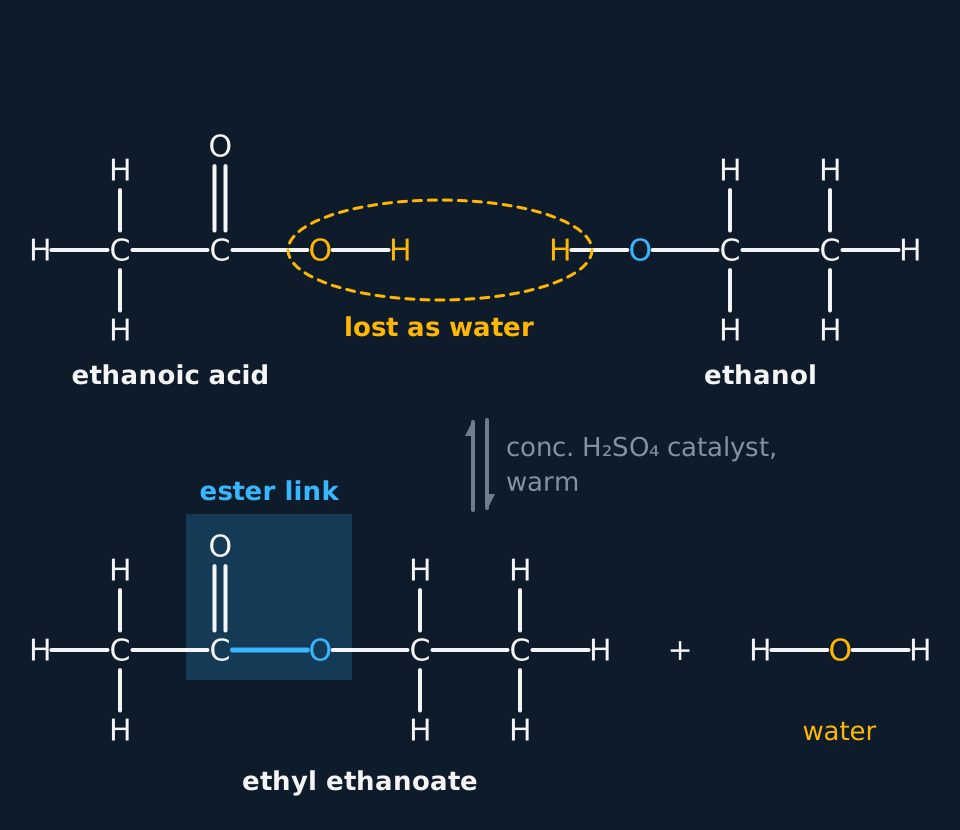
A carboxylic acid and an alcohol join to form an ester. Ethanoic acid warmed with ethanol and a few drops of concentrated sulfuric acid gives ethyl ethanoate, with the sweet smell of nail-varnish remover. The reaction is esterification, a condensation reaction in which the acid and the alcohol join and a molecule of water is lost. The sulfuric acid is a catalyst. The reaction is reversible and reaches equilibrium with about two thirds of the acid converted, so the yield is never complete.
CH₃COOH(l) + CH₃CH₂OH(l) ⇌ CH₃COOCH₂CH₃(l) + H₂O(l)Concentrated H₂SO₄ catalyst, warm
The water comes from the acid's OH and the alcohol's H, not the other way round. Make the ethanol with oxygen-18 in its OH group, and all of the oxygen-18 ends up in the ester and none in the water. The C–O bond of the alcohol survives; the C–OH bond of the acid breaks.
Describe the drawing
Ethanoic acid and ethanol drawn displayed side by side, with the acid's OH and the alcohol's hydrogen enclosed in one dashed ring labelled lost as water. An equilibrium arrow marked concentrated sulfuric acid catalyst and warm leads to ethyl ethanoate drawn displayed, with the –COO– ester link shaded, plus a molecule of water. The alcohol's oxygen is coloured cyan in ethanol and again as the linking oxygen of the ester; the acid's OH oxygen and the water's oxygen are both amber.
The yield can be raised by using an excess of the cheaper reactant or by distilling the ester off as it forms, since ethyl ethanoate boils at 77 °C, below everything else in the flask. Concentrated sulfuric acid also absorbs some of the water, which helps.
An ester's name has two words, and the alcohol part comes first. The alcohol gives the alkyl group, methyl, ethyl, propyl; the acid gives the -oate, methanoate, ethanoate, propanoate. Ethanol and propanoic acid give ethyl propanoate, CH₃CH₂COOCH₂CH₃. The formula is written acid part first, so a name read off a formula has to be reversed: in CH₃COOCH₃ the CH₃CO part is from ethanoic acid and the OCH₃ from methanol, giving methyl ethanoate.
In the laboratory the mixture is heated under reflux so that the volatile ethanol and ester are not lost, then the ester is distilled off. The distillate still holds some acid, so it is shaken with sodium carbonate solution in a separating funnel, releasing the pressure as carbon dioxide forms, and the lower aqueous layer is run off. The ester is dried over anhydrous calcium chloride and redistilled, collecting the fraction that boils within a degree or two of 77 °C.
Naming three esters
Name the esters CH₃CH₂COOCH₃, HCOOCH₂CH₂CH₃ and CH₃COOCH₂CH₂CH₂CH₂CH₃.
Show the working
In CH₃CH₂COOCH₃ the acid part, including the C=O, is CH₃CH₂CO, three carbons, so propanoate. The alkyl group on the single-bonded oxygen is CH₃, methyl. The ester is methyl propanoate.
In HCOOCH₂CH₂CH₃ the acid part is HCO, one carbon, so methanoate; the alkyl group is propyl. The ester is propyl methanoate.
In CH₃COOCH₂CH₂CH₂CH₂CH₃ the acid part is CH₃CO, ethanoate, and the alkyl group has five carbons, pentyl. The ester is pentyl ethanoate, the pear-drop smell. Counting the carbons on each side of the single-bonded oxygen, never the total, gives the two halves of the name.
Percentage yield of ethyl ethanoate
6.00 g of ethanoic acid is heated under reflux with excess ethanol and concentrated sulfuric acid. After purification, 5.28 g of ethyl ethanoate is collected. Calculate the percentage yield. Mr: CH₃COOH 60.0; CH₃COOCH₂CH₃ 88.0.
Show the working
Moles of acid = 6.00 ÷ 60.0 = 0.100 mol.
The equation is 1 : 1, so the maximum amount of ester is 0.100 mol, a maximum mass of 0.100 × 88.0 = 8.80 g.
Percentage yield = 5.28 ÷ 8.80 × 100 = 60.0%.
The yield falls short of 100% because the reaction reaches equilibrium, and some ester is lost in separating and distilling it.
- Esterification
- The reaction of a carboxylic acid with an alcohol, catalysed by a strong acid, to form an ester and water.
- Condensation reaction
- A reaction in which two molecules join together with the loss of a small molecule such as water.
Uses of esters, and breaking them apart
Small esters are volatile and have sweet, fruity smells, so they are used in perfumes and as food flavourings: pentyl ethanoate smells of pear drops and bananas. They are polar enough to dissolve many organic compounds and volatile enough to evaporate away, so ethyl ethanoate is used as a solvent in nail-varnish remover and glues. Larger esters are added to PVC as plasticisers: their molecules sit between the polymer chains, push them apart and let them slide, which turns rigid PVC into flexible cable insulation.
Hydrolysis splits an ester using water. Heated under reflux with dilute acid, an ester gives back its carboxylic acid and alcohol. This is the reverse of esterification and reaches the same equilibrium, so the hydrolysis is incomplete.
CH₃COOCH₂CH₃(l) + H₂O(l) ⇌ CH₃COOH(aq) + CH₃CH₂OH(aq)Dilute H₂SO₄ or HCl, heat under reflux
Heated under reflux with aqueous sodium hydroxide, the ester is hydrolysed completely. The acid formed is at once neutralised to its carboxylate salt, and the carboxylate ion does not react with the alcohol, so the reverse reaction cannot occur. To recover the carboxylic acid itself, the solution is acidified afterwards.
CH₃COOCH₂CH₃(l) + NaOH(aq) → CH₃COONa(aq) + CH₃CH₂OH(aq)
| Acid hydrolysis | Alkaline hydrolysis | |
|---|---|---|
| Reagent | Dilute H₂SO₄ or HCl | Aqueous NaOH |
| Products | Carboxylic acid and alcohol | Carboxylate salt and alcohol |
| Extent | Reversible, incomplete | Goes to completion |
| Why | Same equilibrium as esterification | The carboxylate ion cannot react with the alcohol |
- Hydrolysis
- The splitting of a molecule by reaction with water, here giving a carboxylic acid or its salt and an alcohol from an ester.
Fats, oils, soap and biodiesel
Vegetable oils and animal fats are esters of propane-1,2,3-triol, glycerol, with three long-chain carboxylic acids called fatty acids. Each of glycerol's three OH groups has formed an ester link, so the molecule is a triglyceride. A fat is solid at room temperature because its chains are saturated and pack closely; an oil has C=C bonds that kink its chains.
Hydrolysis of a triglyceride follows the same two patterns as any ester. Heated with dilute acid, it gives glycerol and the free fatty acids, reversibly; this is also what happens slowly when butter turns rancid, and the free butanoic acid released gives the smell. Heated with alkali, it gives glycerol and the salts of the fatty acids, completely.
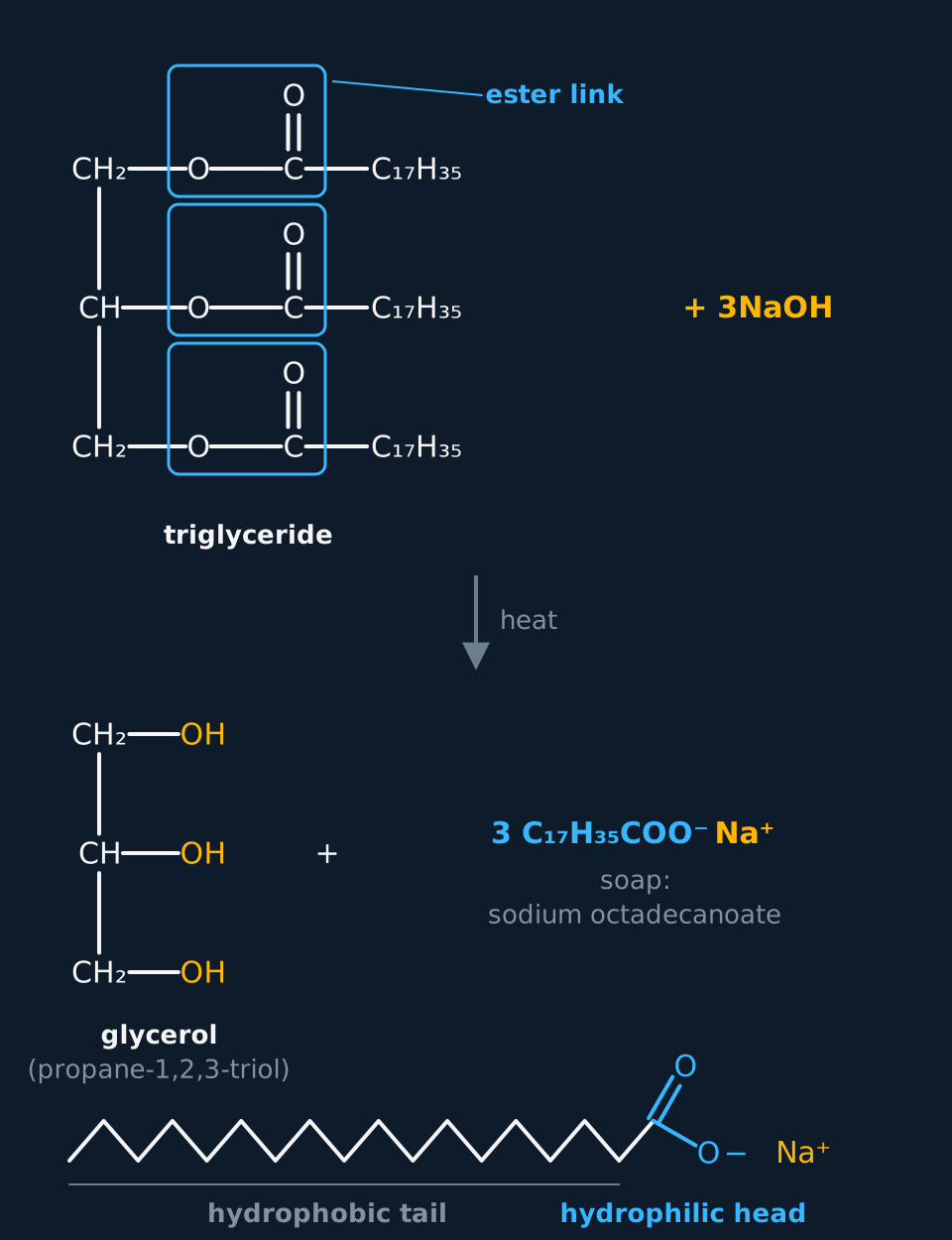
Boiling a fat with concentrated sodium hydroxide hydrolyses all three ester links. The products are glycerol and the sodium salts of the fatty acids, which are soap. Sodium octadecanoate, C₁₇H₃₅COONa, is a typical soap. Its long hydrocarbon tail dissolves in grease and its ionic COO⁻ head dissolves in water, so grease is carried off in the wash.
(C₁₇H₃₅COO)₃C₃H₅(s) + 3NaOH(aq) → 3C₁₇H₃₅COONa(aq) + C₃H₅(OH)₃(aq)Saponification: one triglyceride, three soap molecules, one glycerol
Describe the drawing
A triglyceride drawn with its glycerol backbone of CH₂, CH and CH₂ running down the page, each carbon joined through an oxygen to C(=O)–C₁₇H₃₅, with the three ester links boxed. Three sodium hydroxide and heat give glycerol, propane-1,2,3-triol, with an OH on each carbon, and three sodium octadecanoate soap units. One soap anion is drawn out as a zigzag of seventeen carbons, labelled the hydrophobic tail, ending in a COO⁻ group labelled the hydrophilic head, beside a sodium ion.
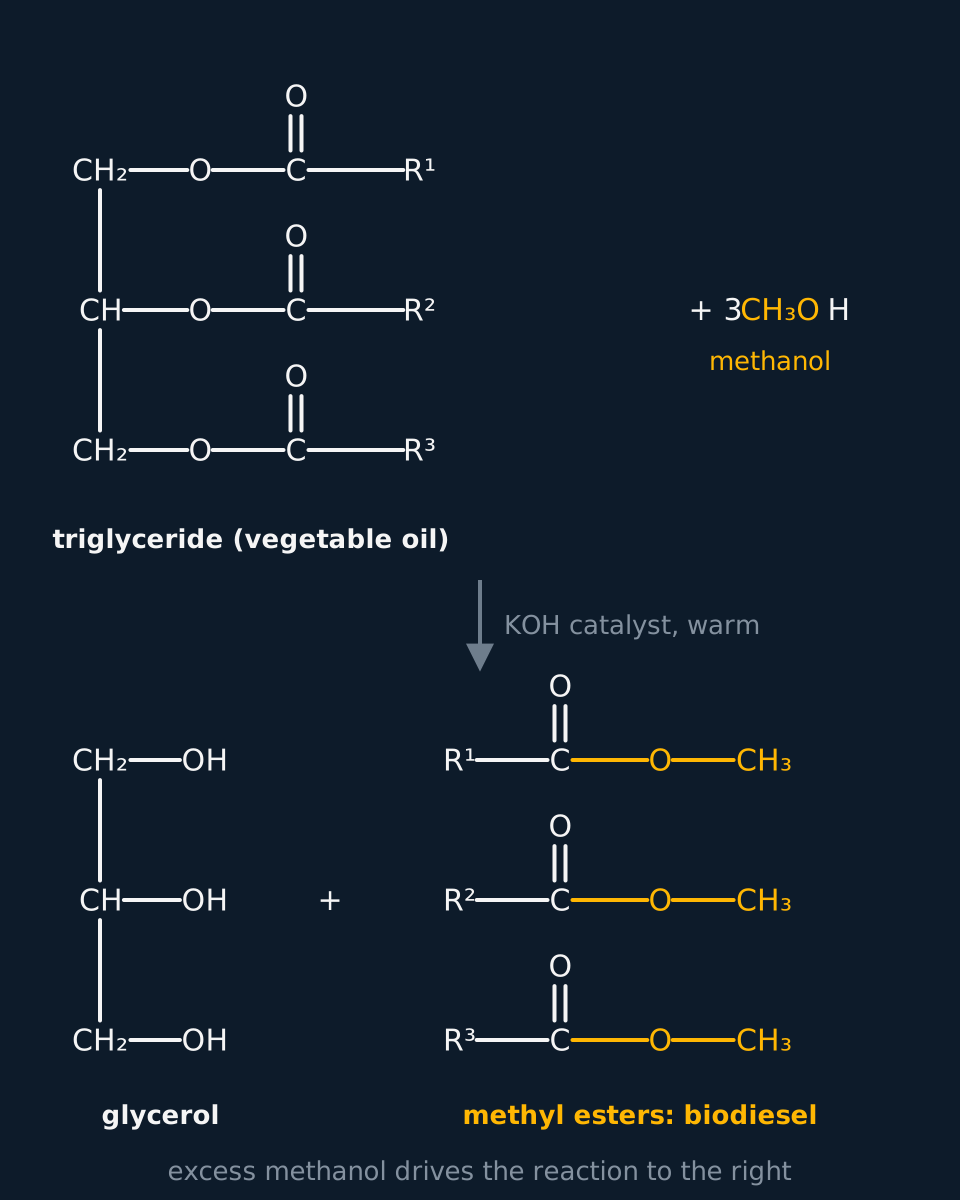
Vegetable oil is too viscous to burn in a diesel engine. Warming it with methanol and a potassium hydroxide catalyst swaps glycerol for methanol in the ester links, a reaction called transesterification. The products are glycerol and a mixture of methyl esters of the fatty acids, which is biodiesel. The methyl esters are smaller molecules than the triglyceride, with weaker van der Waals forces between them, so they flow and burn like diesel.
(RCOO)₃C₃H₅(l) + 3CH₃OH(l) → 3RCOOCH₃(l) + C₃H₅(OH)₃(l)KOH catalyst; R is a long hydrocarbon chain
Describe the drawing
A triglyceride from vegetable oil, drawn with a glycerol backbone and three ester links ending in groups R¹, R² and R³, plus three methanol molecules with their CH₃O coloured amber. An arrow labelled KOH catalyst, warm, leads to glycerol with three OH groups and three methyl esters, R¹, R² and R³ each joined to C(=O)–O–CH₃, the O–CH₃ in amber to show it came from methanol. These methyl esters are biodiesel.
Biodiesel is sometimes described as carbon-neutral, because the carbon dioxide released when it burns was taken in by the crop that made the oil. That claim ignores the fuel burned in farming, fertiliser manufacture, transport and processing, and the methanol is usually made from natural gas, so in practice it is not. Land used to grow oil crops is also land not growing food. Against that, the oil is renewable where crude oil is not, and biodiesel contains almost no sulfur, so burning it gives off little sulfur dioxide.
The glycerol formed in both soap-making and biodiesel production is a valuable by-product. In biodiesel production it is denser than the methyl esters and does not mix with them, so it settles out as a lower layer and is run off, then purified and sold for use in cosmetics, food and medicines.
TRY IT: Biodiesel from a single triglyceride
A triglyceride is made from glycerol and three molecules of hexadecanoic acid, C₁₅H₃₁COOH. Write the equation for its transesterification with methanol, and name the biodiesel molecule formed.
Check your answer
The triglyceride is (C₁₅H₃₁COO)₃C₃H₅. Three molecules of methanol each replace one glycerol link: (C₁₅H₃₁COO)₃C₃H₅ + 3CH₃OH → 3C₁₅H₃₁COOCH₃ + C₃H₅(OH)₃.
The biodiesel molecule is the methyl ester of hexadecanoic acid. The alcohol part is named first, so it is methyl hexadecanoate.
- Triglyceride
- An ester formed from propane-1,2,3-triol (glycerol) and three fatty acid molecules.
- Biodiesel
- A mixture of methyl esters of long-chain carboxylic acids, made by transesterification of vegetable oils with methanol.
- Saponification
- The alkaline hydrolysis of a fat or oil, giving glycerol and the salts of the fatty acids, which are soap.
- Transesterification
- The exchange of the alcohol part of an ester for another alcohol, as when methanol replaces glycerol in making biodiesel.
Other boards: acid strength, nitriles and LiAlH₄
Cambridge asks for carboxylic acids, phenols and alcohols to be put in order of acid strength, with the reason. Each releases H⁺ from an O–H group; what differs is how stable the anion left behind is. The more widely its negative charge is spread, the more stable the anion, the further the equilibrium lies to the right, and the stronger the acid.
In the ethanoate ion the charge is delocalised over both oxygen atoms: the two C–O bonds are identical in length, between a single and a double bond. In the phenoxide ion, C₆H₅O⁻, a lone pair on the oxygen overlaps with the delocalised π system of the ring, so some of the charge spreads onto the ring, but most stays on the one oxygen. In the ethoxide ion, CH₃CH₂O⁻, the charge sits on one oxygen alone, and the ethyl group pushes electron density towards it, which destabilises it further. Ethanol is a weaker acid even than water, whose hydroxide ion has no alkyl group.
| Ethanoic acid | Phenol | Ethanol | |
|---|---|---|---|
| pKa | 4.8 | 10.0 | About 16 |
| Reacts with sodium | Yes, H₂ given off | Yes, H₂ given off | Yes, H₂ given off |
| Reacts with NaOH(aq) | Yes | Yes | No |
| Fizzes with Na₂CO₃ | Yes | No | No |
| Charge on the anion | Delocalised over two O atoms | Partly spread into the ring | On one O, pushed in by the alkyl group |
Chlorine atoms on the carbon next to the COOH group make the acid stronger. Chlorine is more electronegative than carbon and draws electron density along the σ bonds away from the COO⁻ group, which spreads its charge further. Each extra chlorine adds to the effect: pKa falls from 4.8 for ethanoic acid to 2.9 for chloroethanoic acid, 1.3 for dichloroethanoic acid and 0.7 for trichloroethanoic acid. The effect fades with distance: 2-chloropropanoic acid, pKa 2.8, is far stronger than 3-chloropropanoic acid, pKa 4.0. Alkyl groups work the other way, releasing electron density towards the COO⁻ group, so methanoic acid, pKa 3.8, with no alkyl group, is stronger than ethanoic acid.
Edexcel, OCR and Cambridge also make carboxylic acids by the hydrolysis of a nitrile. Heated under reflux with dilute hydrochloric acid, a nitrile gives the carboxylic acid and an ammonium salt. Heated with aqueous sodium hydroxide, it gives the carboxylate salt and ammonia, and the acid is freed afterwards by adding a strong acid.
CH₃CH₂CN(l) + 2H₂O(l) + HCl(aq) → CH₃CH₂COOH(aq) + NH₄Cl(aq)Propanenitrile to propanoic acid, dilute HCl, reflux
CH₃CH₂CN(l) + NaOH(aq) + H₂O(l) → CH₃CH₂COONa(aq) + NH₃(g)In alkali the salt forms and ammonia is given off
A nitrile is made from a halogenoalkane and cyanide ions, so the two steps together lengthen the chain by one carbon: bromoethane gives propanenitrile, which gives propanoic acid. A hydroxynitrile made from an aldehyde is hydrolysed likewise to a 2-hydroxy acid. Cambridge also makes benzoic acid by heating methylbenzene under reflux with alkaline potassium manganate(VII) and then acidifying: the side chain is oxidised to COOH.
Methanoic acid, HCOOH, is the one carboxylic acid that is still a reducing agent. Its carbon carries a hydrogen, as an aldehyde's does, so it gives a silver mirror with Tollens' reagent and decolourises acidified potassium manganate(VII), being oxidised to carbon dioxide and water. Cambridge examines this; ethanoic acid gives neither result.
HCOOH(aq) + [O] → CO₂(g) + H₂O(l)
NaBH₄ does not reduce carboxylic acids. Lithium tetrahydridoaluminate(III), LiAlH₄, in dry ether does, and takes them straight to the primary alcohol; the aldehyde formed on the way is reduced at once and is not isolated. Edexcel and Cambridge examine this; AQA does not.
CH₃COOH(l) + 4[H] → CH₃CH₂OH(l) + H₂O(l)LiAlH₄ in dry ether, then dilute acid
OCR also asks for the esterification of an amino acid. Heated with methanol and concentrated sulfuric acid, glycine's COOH group is esterified in the usual way. The strong acid also protonates the amine group, so the product is the salt of the methyl ester.
H₂NCH₂COOH(s) + CH₃OH(l) + H⁺(aq) → ⁺H₃NCH₂COOCH₃(aq) + H₂O(l)Glycine to its methyl ester, concentrated H₂SO₄, heat
In the exam
- Naming an ester from its formula starts at the C=O: the part containing it is from the acid and is named second. The scheme rejects 'ethanoate ethyl' and 'ethyl ethanoic'.
- To explain why alkaline hydrolysis is complete, state that the carboxylate ion formed cannot react with the alcohol.
- Esterification conditions earn the mark as concentrated sulfuric acid and heat. 'Acid catalyst' alone does not name the reagent, and dilute sulfuric acid is not accepted.
- A biodiesel equation is balanced with three methanol and three methyl esters for each triglyceride, and glycerol shown as C₃H₅(OH)₃ or displayed; an unbalanced equation loses the equation mark.
- Each use of an ester is credited only with the property behind it: smell for flavourings, volatility and solvent power for glues, sitting between chains for plasticisers.
Check yourself
A student hydrolyses methyl propanoate by heating it with dilute hydrochloric acid, and a second sample by heating it with aqueous sodium hydroxide. Compare the products and the extent of each reaction, and say how the student could obtain propanoic acid from the second mixture.
Answer
With dilute acid the ester is hydrolysed to propanoic acid, CH₃CH₂COOH, and methanol. The reaction is the reverse of esterification and reaches equilibrium, so some ester remains.
With sodium hydroxide the products are sodium propanoate, CH₃CH₂COONa, and methanol. The propanoic acid formed is neutralised at once, and the propanoate ion does not react with methanol, so the hydrolysis goes to completion.
Adding a strong acid such as dilute hydrochloric acid to the second mixture converts the propanoate ions back to propanoic acid.
Questions
Question 16 marksAQA
Evaluate biodiesel made from rapeseed oil as a replacement for diesel from crude oil, including the claim that it is carbon-neutral.
Mark scheme
Indicative content
- the carbon dioxide released on burning was taken in by the rapeseed plants during photosynthesis, which supports the claim of carbon neutrality
- fossil fuels are burned in farming, making fertiliser, transport and processing, so extra carbon dioxide is released overall
- the methanol used in transesterification is usually made from natural gas, a fossil fuel, so the claim is not fully supported
- the oil is a renewable resource, where crude oil is finite, and biodiesel contains almost no sulfur, so little sulfur dioxide forms
- land used to grow oil crops is land not growing food, which can raise food prices or lead to forest clearance
- a justified conclusion: biodiesel releases less fossil carbon than diesel but is not carbon-neutral, so it reduces rather than removes the impact
Levels
- Level 3 (5–6 marks) the basis of the carbon-neutral claim is explained through photosynthesis, the fossil-fuel inputs including the methanol are identified, the renewability and low sulfur of biodiesel and the land-use cost are all weighed, and a justified conclusion is drawn that it reduces rather than removes the impact
- Level 2 (3–4 marks) the claim is explained and at least one fossil-fuel input named, with one more advantage or drawback; the conclusion is absent or does not follow from the points made
- Level 1 (1–2 marks) biodiesel is accepted as carbon-neutral because it comes from plants, with no fossil-fuel input such as the methanol or the fertiliser considered
Question 24 marks
Describe a chemical test that shows an unknown liquid is ethanoic acid rather than ethanol, giving the observations, an equation for the reaction and the name of the salt formed.
Mark scheme
- B1 add solid sodium carbonate or sodium hydrogencarbonate to each liquid
- B1 ethanoic acid effervesces, giving a gas that turns limewater milky; ethanol gives no change
- B1 2CH₃COOH + Na₂CO₃ → 2CH₃COONa + H₂O + CO₂; allow the hydrogencarbonate equation
- B1 the salt is sodium ethanoate
Question 34 marks
Compare the hydrolysis of methyl ethanoate by dilute sulfuric acid with its hydrolysis by aqueous sodium hydroxide.
Mark scheme
- B1 both are carried out by heating under reflux, and both give methanol
- B1 acid hydrolysis gives ethanoic acid, while alkaline hydrolysis gives sodium ethanoate
- B1 acid hydrolysis is reversible and incomplete, while alkaline hydrolysis goes to completion
- B1 in acid, H₂SO₄ is a catalyst, while in alkali the hydroxide is used up in the reaction
All 21 questions with mark schemes, the other 18 set out in full on the question page.
Worth remembering
- Weak means slightly dissociated, not dilute: a weak acid still reacts completely with a base.
- The water in esterification takes its O from the acid, not the alcohol.
- Read an ester's formula from the C=O: that side is the acid and is named second.
- Alkaline hydrolysis gives the carboxylate salt, not the acid, until a strong acid is added.
- A triglyceride needs three NaOH or three CH₃OH, and gives one glycerol.
CHECK YOUR PROGRESS
Rate how confident you are with each objective for this lesson. Ratings are saved in this browser, on this device, unless you sign in.
- Explain why carboxylic acids are weak acids, and write equations for their reactions with carbonates, bases and metals.
- Describe the esterification of a carboxylic acid with an alcohol, and name the ester formed.
- Give uses of esters linked to their properties.
- Compare the hydrolysis of an ester in acid with its hydrolysis in alkali.
- Describe how soap and biodiesel are made from a triglyceride, with equations.
- Write equations for the hydrolysis of a nitrile to a carboxylic acid in acid and in alkali.CAIE · Edexcel · OCR A
Open the full revision checklist to see every objective in the curriculum in one place.
Practise this lesson
WORKBOOK
The written questions from this topic, on paper with room to work, and a separate book of mark schemes. The question that is set on a diagram stays on this page, where the diagram can be drawn. Free to use; please do not redistribute or sell.
Used later in Condensation polymers and the disposal of polymers · Preparing, purifying and testing an organic solid and liquid