Maths › Further Statistics 2 › Combinations of normal random variables
Combinations of normal random variables
A linear combination of independent normal variables is itself normal. The means combine with the signs of the combination, while the variances add and the coefficients square, even for a difference. Find the distribution of aX ± bY and use it to answer probability questions, stating the independence the variance rule requires.
Builds on The normal distribution and Discrete random variables and expectation.
IN THIS TOPIC
- Write down the distribution of aX ± bY for independent normal X and Y.
- Distinguish the sum of n independent copies from n times a single one.
- Use the combined distribution to answer a probability question.
COMMON MISCONCEPTION
For independent X and Y, the variance of X − Y is Var(X) − Var(Y).
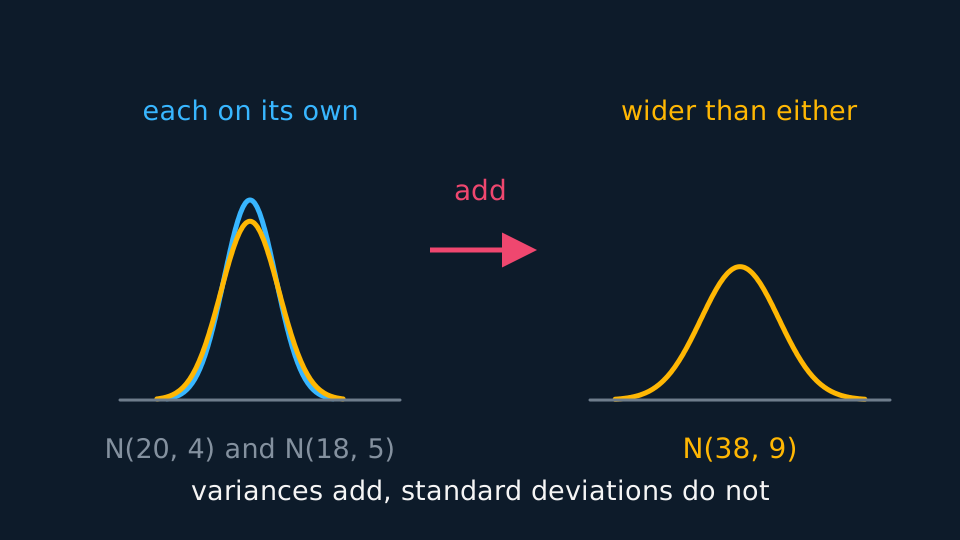
Under independence the variances add for a difference as well as for a sum, so Var(X − Y) = Var(X) + Var(Y). Two independent sources of variation both contribute whichever way the variables are combined, and subtracting could return a negative value whenever Y varied more than X. For independent N(20, 4) and N(18, 5), X − Y is N(2, 9).
Linear combinations of independent normal variables
If X is N(μx, σx²) and Y is N(μy, σy²) independently, then any linear combination is normal too, with a mean that follows the signs. Pearson Edexcel 9FM0 formulae booklet: neither the normality of the combination nor this mean is included.
The variance rule requires independence:
Pearson Edexcel 9FM0 formulae booklet: included, under Expectation algebra, stated for independent X and Y. For independent X and Y, Var(aX ± bY) = a²Var(X) + b²Var(Y). Without independence, the covariance term is needed: Var(aX ± bY) = a²Var(X) + b²Var(Y) ± 2ab Cov(X, Y). Under independence the signs in the mean follow the combination while the variances add and the coefficients square, so subtracting does not reduce the variance: two independent sources of variation both contribute whichever way the variables are combined. Subtracting the variances could also give a negative value whenever Y varied more than X, which no variance can take.
WORKED EXAMPLE
Which of two is larger
X is N(20, 4) and Y is N(18, 5), independently. Find P(Y > X).
Work with the difference. X − Y is N(20 − 18, 4 + 5) = N(2, 9), with standard deviation 3.
P(Y > X) = P(X − Y < 0) = P(Z < (0 − 2)/3) = P(Z < −0.667).
That is 0.252 to three decimal places. Note the variance 9, and not 4 − 5.
Independent and repeated normal variables
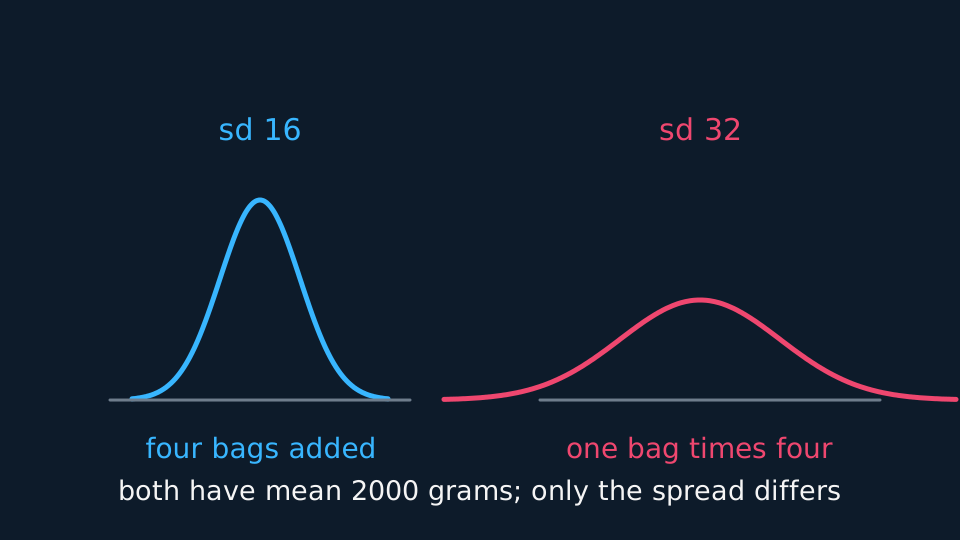
Adding four independent copies of X gives variance 4σ², since each copy contributes its own. Multiplying one X by 4 gives variance 16σ², since the coefficient squares. Both have mean 4μ, so the two cases differ only in the variance. Read the context carefully to decide which applies.
In context: four separate bags vary independently, so their deviations partly cancel and the total is relatively less variable than four times one bag. Scaling a single bag by 4 scales its deviation by 4 as well.
GUIDED PRACTICE
Telling the two apart
Bags of flour have weight N(500, 64) grams. Find the distribution of the total weight of four bags, and of four times the weight of one bag.
Show the working
Four bags: mean 4 × 500 = 2000, variance 4 × 64 = 256, so N(2000, 256) with standard deviation 16.
Four times one bag: mean 2000, variance 4² × 64 = 1024, so N(2000, 1024) with standard deviation 32.
Same mean, double the spread. Independent errors partly cancel; a scaled-up single error does not.
ASSESSMENT FOCUS
- Write the new distribution in full, N(mean, variance), before standardising anything.
- For independent variables, add the variances even for a difference, and square every coefficient first.
- For 'is X bigger than Y', form X − Y and ask for the probability that it is positive.
- State the independence assumption. Without it the variance formula needs the covariance term.
CHECK YOURSELF
X is N(30, 9) and Y is N(10, 16), independently. State the distribution of 2X − 3Y.
Show a hint
Means follow the signs; variances add with squared coefficients.
Show the answer
Mean 2(30) − 3(10) = 30. Variance 4(9) + 9(16) = 36 + 144 = 180. So 2X − 3Y is N(30, 180).
For independent normals, aX ± bY is normal with mean aμx ± bμy and variance a²σx² + b²σy²; without independence the covariance term is required.
Under independence, variances add for a difference as well as a sum, and n independent copies give variance nσ² while n times one gives n²σ².
WORKBOOK
Printable practice for this topic: original exam-style questions with room to work, and a fully worked answer book. Free to use; please do not redistribute or sell.
Or read them with their worked answers on the combinations of normal random variables questions page.
USED LATER IN
CHECK YOUR PROGRESS
Rate how confident you feel with each objective for this lesson. Ratings are saved in this browser, on this device, unless you sign in.
- Write down the distribution of aX ± bY for independent normal X and Y.
- Distinguish the sum of n independent copies from n times a single one.
- Use the combined distribution to answer a probability question.
Open the full revision checklist to see every objective in the course in one place.