Physics › Capacitance › Energy stored and capacitor combinations
Energy stored and capacitor combinations
A capacitor's stored energy is the area under its graph of pd against charge, the triangle ½QV, so doubling the charging pd quadruples it. Three equivalent forms follow. Capacitors in parallel add while in series their reciprocals add, each the reverse of the resistor rule.
Choose your exam board to show the notes and questions relevant to your specification. You can change this setting at any time, and content for other boards remains available.
Watch Energy stored in capacitors on the InkPhysics YouTube channel
Capacitors and energy stored, part 2 of 2. Part 1 is Capacitors and the dielectric.
Builds on Capacitors and the dielectric and Electric potential.
IN THIS TOPIC
- Find the stored energy from the area under a V against Q graph.
- Choose between the three energy forms according to the quantities a question supplies.
- For CIE and OCR, derive the series and parallel combination formulas and use them.
COMMON MISCONCEPTION
A capacitor is a small battery.
A battery is a source of emf, converting chemical energy at a near-steady voltage; a capacitor only stores separated charge, and its pd falls as soon as it discharges.
The energy, and why the half
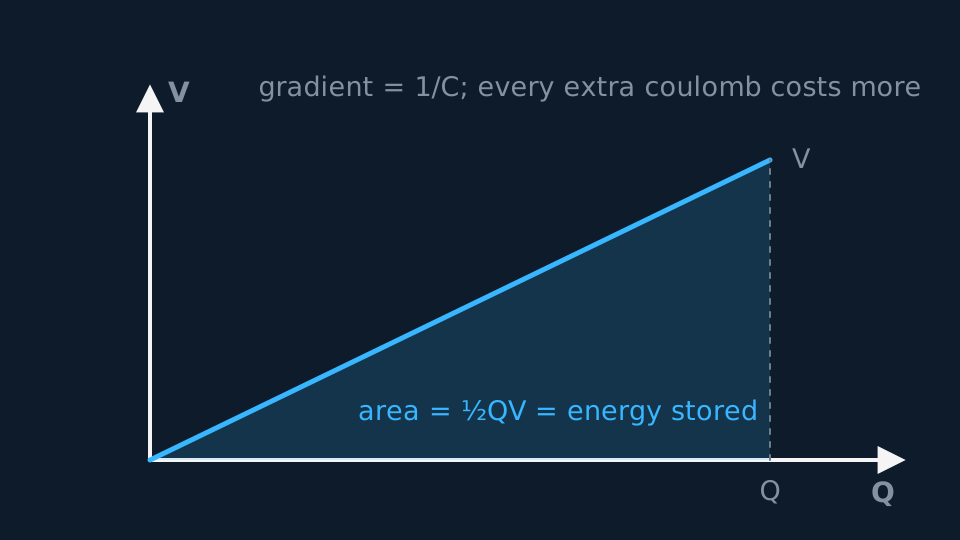
Charging a capacitor transfers charge against the pd already across it. The incremental work needed to add charge ΔQ at potential difference V is VΔQ, so on a graph of pd on the vertical axis against charge on the horizontal each narrow strip of area under the line is one such increment. The total energy stored is therefore the area under that line. The first increment is added while the plates are almost uncharged, and the last is added against the full pd.
Since Q = CV the line is straight and passes through the origin, so its gradient is 1/C and the area is the triangle ½QV. With the axes the other way round, charge against pd, the same data give a line of gradient C, which is the plot to use when a question asks for the capacitance. Only the pd-against-charge plot has an area equal to the work done. For a straight line the swapped plot happens to give the same number, but it would not for a component whose graph is curved, so put V on the vertical axis whenever the energy is required.
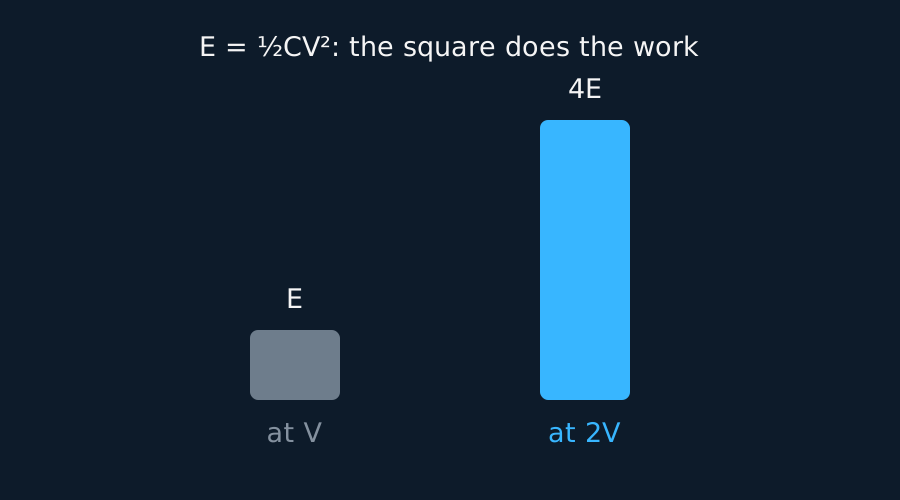
with the other two forms reached by substituting Q = CV. The square in ½CV2 means that doubling the charging pd quadruples the energy stored. A battery transfers energy from chemical stores and holds its pd nearly constant until it is discharged. A capacitor stores energy in the electric field between its plates, its pd falls as the charge drains away, and it can transfer the whole store in milliseconds, which is what a camera flash requires.
GUIDED PRACTICE
The energy, and the quadrupling
Find the energy stored by the 2200 μF flash capacitor met in part 1, at 5.0 V and then at 10 V, choosing the form of the energy equation that uses what you know.
Show the working
E = ½CV2 = ½ × 2200 × 10−6 × 5.02 = 0.028 J.
At 10 V the energy is four times as large, 0.11 J, because the pd is squared. Doubling the pd doubles the charge stored and doubles the average pd at which it was stored, and the two factors multiply.
INDEPENDENT PRACTICE
Why the flash is bright
The same capacitor dumps its 5.0 V store, 0.028 J, through a flash tube in about 1.0 ms. Estimate the average power, and compare it with charging the capacitor from a small 0.50 W charger.
Show the working
P = E/t = 0.028/(1.0 × 10−3) = 28 W during the flash.
Charging at 0.50 W takes about 0.06 s, so the flash transfers the same energy back more than fifty times faster than it was supplied. A capacitor stores a small amount of energy and can deliver it in a very short time.
Capacitors in series and in parallel, for CIE and OCR
Two boards require the combination rules. CIE requires the combined-capacitance formulas to be derived from C = Q/V and then used; OCR requires them to be used, and circuits built from capacitors and resistors to be analysed with them. AQA and Edexcel require neither. Both results follow from the defining equation and one conservation law.
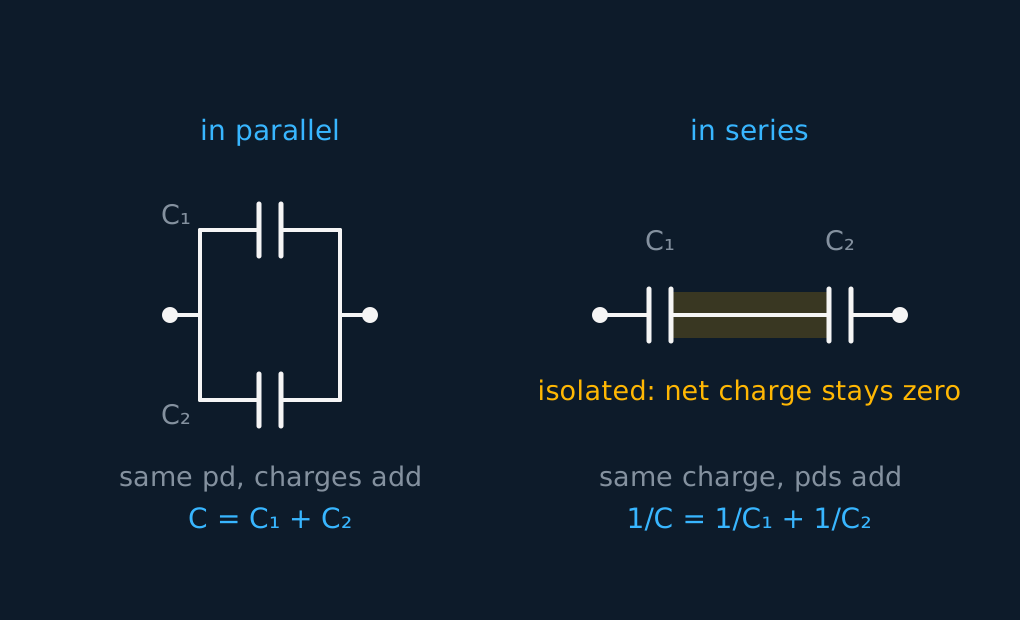
Take parallel first. Connecting the capacitors between the same pair of points puts the same pd across every one of them. Each stores the charge set by its own capacitance, Q1 = C1V and Q2 = C2V and so on, and the total charge supplied is the sum of those. Writing the sum as Q = C1V + C2V + …, and dividing by the shared pd, the definition C = Q/V gives a single capacitance for the whole group,
which is consistent with the geometry: capacitors side by side are equivalent to one capacitor of larger plate area, and A is in the numerator of the plate formula.
The series result follows from conservation of charge, and that statement carries the derivation mark. Consider the length of conductor running from the inner plate of the first capacitor to the inner plate of the second. It is connected to nothing else, so it is isolated, and it was initially neutral, so it must remain neutral. When the supply moves charge +Q onto the outer plate of the first capacitor, the isolated section carries −Q at one end and +Q at the other, and the same argument repeats along the chain. Every capacitor in a series string carries the same charge Q, whatever their individual capacitances.
The pds are not shared but added: V = V1 + V2 + …, with each Vn = Q/Cn from the definition rearranged, while the group as a whole obeys V = Q/C. Substituting into the sum, the shared Q cancels from every term, leaving
which is again consistent with the geometry: capacitors connected in series are equivalent to plates further apart, and d is in the denominator of the plate formula.
Both results are the reverse of the corresponding resistor rules, which is a common source of error. The reason lies in what each quantity measures. Resistance measures opposition, so more of it makes charge harder to move; capacitance measures capacity to store charge, so more of it stores more charge at a given pd. Adding a component in series makes the transfer harder either way, and that reads as a larger R and a smaller C.
Identifying which quantity adds makes the two sets of rules consistent. In series what adds is the pd required per unit of throughput: volts per ampere for a resistor and volts per coulomb for a capacitor, and volts per coulomb is 1/C. In parallel what adds is the response per volt: amperes per volt for a resistor and coulombs per volt for a capacitor, and coulombs per volt is C itself.
Two checks follow. A series combination is always smaller than the smallest capacitor in it, and a parallel combination is always larger than the largest. Test every answer against them.
WORKED EXAMPLE
A series pair, and the pd it splits
A 2.0 μF capacitor and a 4.0 μF capacitor are joined in series across a 9.0 V supply. Find the combined capacitance, the charge on each, and the pd across each.
Reciprocals first. 1/C = 1/2.0 + 1/4.0 = 0.75 in reciprocal microfarads, so C = 1/0.75 = 1.3 μF, below the smaller of the two as a series result must be.
The group stores Q = CV = (4/3) × 9.0 = 12 μC, working in microfarads and volts so the charge lands in microcoulombs. That same 12 μC is on both capacitors, because the isolated conductor between them stays neutral.
Now split the pd. V1 = Q/C1 = 12/2.0 = 6.0 V and V2 = 12/4.0 = 3.0 V, and they add to the 9.0 V supply, which is the check on the working.
The smaller capacitor takes the larger share of the pd, which is the reverse of a resistor chain. Both hold the same charge, so the one with the smaller capacitance needs a larger pd to hold it.
GUIDED PRACTICE
The same pair in parallel, then through a resistor
Rewire those 2.0 μF and 4.0 μF capacitors in parallel across the same 9.0 V supply, and find the combined capacitance and the total charge stored. The supply is then disconnected and the pair is left to discharge through a 22 kΩ resistor. The timescale of such a discharge is set by the time constant, the product RC, which is covered two lessons later. Find it for the parallel pair, and compare it with the value for the series arrangement.
Show the working
C = C1 + C2 = 2.0 + 4.0 = 6.0 μF, above the larger of the two, and Q = CV = 6.0 × 9.0 = 54 μC, four and a half times the charge stored by the series pair on the same supply.
With the resistor in the loop this is an ordinary resistor-capacitor discharge, and the combination behaves as one 6.0 μF capacitor. RC = 22 000 × 6.0 × 10−6 = 0.13 s.
The series pair, of capacitance 1.3 μF, would give RC = 22 000 × 1.3 × 10−6 = 0.029 s, shorter by the same factor of four and a half. A smaller combined capacitance holds less charge at the same pd, so the same resistor discharges it sooner. The method is the same in every case: reduce the group to a single capacitance, then treat it as one component.
ASSESSMENT FOCUS
- Choose the energy form that matches the data given: ½QV when both Q and V are known, ½CV2 from the capacitance and the pd, and ½Q2/C when the charge is known.
- The factor of a half is itself examinable. Each additional increment of charge is transferred against a larger pd, so the average pd during charging is V/2 and the area under the line is a triangle.
- Check the axes when a graph is involved. Work is pd × charge transferred, so the energy is the area under pd against charge, which is how every board words it. The gradient of the plot with the axes swapped, charge against pd, is the capacitance.
- CIE and OCR only: derive the parallel result from a shared pd and added charges, and the series result from a shared charge and added pds. The series derivation requires the conservation-of-charge statement, that the conductor between the two capacitors is isolated and stays neutral, so write it out rather than assume it.
- Series capacitance comes out smaller than the smallest capacitor, parallel larger than the largest, and the smaller capacitor in a series pair takes the larger pd. Each of those is the reverse of the resistor rule, so check a combination against them.
CHECK YOURSELF
A 2200 μF flash capacitor is charged to 6.0 V. Find the charge and the energy it stores, and the pd it would need for four times that energy.
Show a hint
Q = CV first, then the energy form that uses the quantities given, then consider which quantity is squared.
Show the answer
Q = CV = 2200 × 10−6 × 6.0 = 0.013 C.
E = ½CV2 = ½ × 2200 × 10−6 × 6.02 = 0.040 J, the form chosen to use the rating and the voltage, the two numbers given.
Four times the energy needs twice the pd, 12 V, because E is proportional to V2. Doubling the pd doubles the charge stored and doubles the average pd at which it is stored, and the two factors multiply.
The energy stored is the area under a graph of V against Q, ½QV, and is proportional to the pd squared.
In parallel capacitances add; in series their reciprocals do, each the reverse of the resistor rule.
Or read them with their mark schemes on the capacitors and the dielectric questions page.
CHECK YOUR PROGRESS
Rate how confident you feel with each objective for this lesson. Ratings are saved in this browser, on this device, unless you sign in.
- Find the stored energy from the area under a V against Q graph.
- Choose between the three energy forms according to the quantities a question supplies.
- For CIE and OCR, derive the series and parallel combination formulas and use them.
Open the full revision checklist to track your progress across the whole unit.