Physics › Electric fields › Electric potential
Electric potential
Electric potential is the work done per unit positive charge in bringing a charge from infinity to the point, and its sign follows the sign of the source charge. V = Q/4πε₀r is positive around a positive charge and negative around a negative one, unlike gravitational potential. A volt is a joule per coulomb, and ΔW = QΔV gives the energy transferred.
Choose your exam board to show the notes and questions relevant to your specification. You can change this setting at any time, and content for other boards remains available.
Builds on Coulomb's law and electric field strength and Gravitational potential.
IN THIS TOPIC
- Define absolute electric potential with its zero at infinity, and use ΔW = QΔV.
- Use the radial potential of a point charge, and read equipotential diagrams.
- Translate between the E and V graphs, gradient in one direction and area in the other.
COMMON MISCONCEPTION
A volt is an amount of energy.
A volt is not an amount of energy; it is one joule per coulomb. The energy transferred depends on the charge moved as well: W = QV.
Joules per coulomb
The absolute electric potential at a point is the work done per unit positive charge in bringing a small test charge from infinity to that point, with the zero at infinity exactly as for gravity. In the radial field of a point charge,
The sign of the potential follows the sign of the source charge. Around a positive charge the potential is positive, because work must be done to bring another positive charge in from infinity; around a negative charge it is negative. Gravitational potential has only one sign, because mass has only one sign.
A volt is a joule per coulomb, so potential and potential difference measure energy per unit charge, and no energy changes hands until a charge actually moves. The energy transferred in moving a charge Q through a potential difference is
which is also the equation underlying the electronvolt met in the quantum unit: the energy transferred when one electron moves through a potential difference of one volt.
Equipotentials, again
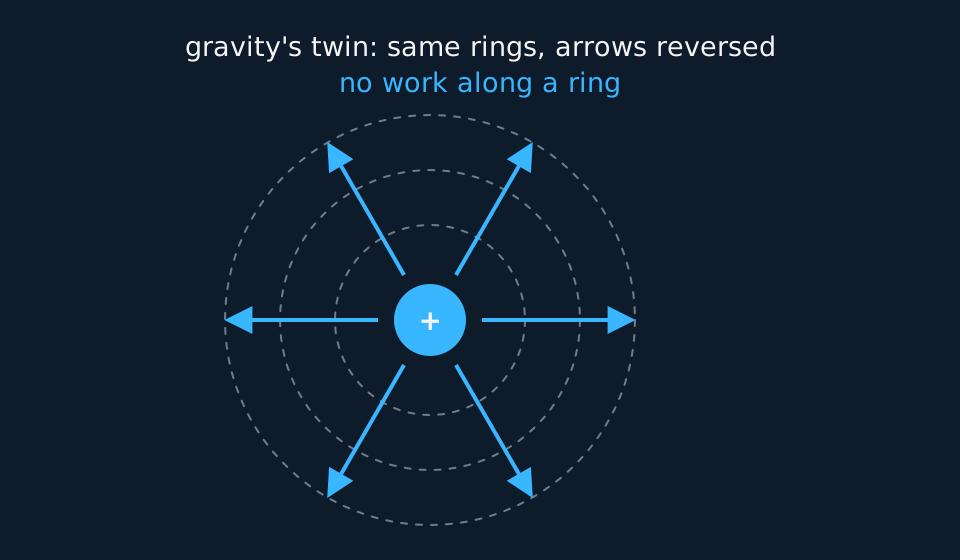
Surfaces of constant potential surround a point charge in the same way as they surround a planet, they cross the field lines at right angles, and no work is done moving a charge along an equipotential. One detail differs from the gravitational case: for a positive central charge the field arrows point outward, and moving inward makes the potential more positive rather than more negative.
OCR adds one corollary. Outside its surface a charged conducting sphere behaves as a point charge at its centre, so a sphere of radius R holding charge Q is at potential V = Q/4πε0R, and the charge it holds is proportional to that potential. The ratio Q/V is its capacitance, C = 4πε0R, so a larger sphere stores more charge per volt.
Reading the E and V graphs
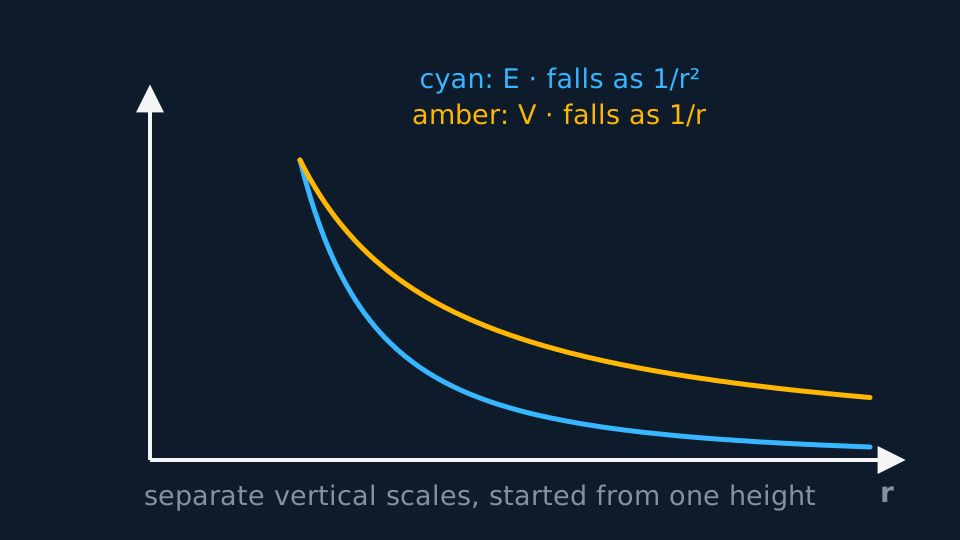
Plotted against distance for a positive charge, V falls as 1/r and E falls as 1/r2, so the field falls away faster than the potential. Two relations connect the graphs:
with the magnitude of the gradient of the V graph giving the field strength, and the area under the E against r graph between two distances giving ΔV. Read the equation as a statement about magnitudes, because the signs depend on the configuration. Around the positive charge above, V falls as r increases, so ΔV/Δr is negative while E points outwards and is counted positive. Written with its sign the relation is E = −ΔV/Δr: the field points down the potential gradient, from high potential to low.
The data booklet prints the electric relation without that minus sign, quoting E as a magnitude, whereas the gravitational version g = −ΔV/Δr keeps it. The physics is the same in both cases; only the printed convention differs. Take the magnitude of the gradient of V against r for the size of E, determine the direction from the field itself, and use the booklet's form for the field you are working in.
WORKED EXAMPLE
Work along and across the map
A +2.0 μC charge moves from a point at a potential of 400 V to a point at 150 V. Find the work done on it by the field, then say what changes if it moves the other way, and find the work needed to move it along an equipotential at 400 V.
Establish the direction before the arithmetic. ΔV is the increase in potential, final minus initial, so ΔV = 150 − 400 = −250 V. The work an external agent must supply is QΔV, and the work done by the field is the negative of that, Wfield = −QΔV.
So Wfield = −(2.0 × 10⁻⁶) × (−250) = +5.0 × 10⁻⁴ J. It is positive because a positive charge moving from 400 V to 150 V moves in the direction of the electric force, so the field transfers energy to it.
For the reverse move, from 150 V to 400 V, every sign reverses. ΔV = +250 V, the field does −5.0 × 10⁻⁴ J of work, and an external agent must supply 5.0 × 10⁻⁴ J. The magnitude of the answer does not depend on the direction; the sign does, and it is set by which point is the start and which the finish.
Along an equipotential ΔV = 0, so the work is zero, however long the path.
The energy transferred depends only on the initial and final potentials, not on the path between them.
GUIDED PRACTICE
Potential at 2r and 4r
The potential at distance r from a point charge is 60 V. Without computing the charge, find the potential at 2r and at 4r.
Show the working
V falls as 1/r, not as 1/r2, so at 2r it reads 30 V and at 4r 15 V.
The inverse square applies to the field strength, not the potential. Potential falls as 1/r, so its graph approaches zero more slowly than the field does.
ASSESSMENT FOCUS
- Define potential with all three parts: work done, per unit positive charge, brought from infinity. The electric definition needs the sign stated; the gravitational one does not.
- ΔW = QΔV runs both ways. Work is supplied when a positive charge climbs to a higher potential and delivered when it falls, so track the signs of Q and ΔV together.
- No work is done along an equipotential, and field lines cross equipotentials at right angles. Both statements carry credit whenever such a diagram appears.
- For the graph relations, the magnitude of the gradient of V against r gives E and the area under E against r gives ΔV. Quote whichever the data supports.
- Follow the booklet's signs exactly: gravity keeps its minus sign in g = −ΔV/Δr, while the electric E = ΔV/Δr is printed as a magnitude. Write "magnitude of the gradient" when quoting it, since the potential around a positive charge falls as r increases and the raw gradient is negative. State which convention you are using.
CHECK YOURSELF
A point charge of +2.0 nC sits in air. Find the potential 0.30 m away, and the work needed to bring a +1.5 nC charge from far away to that point.
Show a hint
Use the radial potential first, then ΔW = QΔV.
Show the answer
= (8.99 × 109 × 2.0 × 10−9) / 0.30 = 60 V.
Coming from infinity, ΔV = 60 V, so = 1.5 × 10−9 × 60 = 9.0 × 10⁻⁸ J.
The work is positive and must be supplied by an external agent, because both charges are positive and the potential rises along the path.
Potential is work per coulomb from infinity, and its sign follows the charge.
The size of the V against r gradient gives E, and the field points down the gradient; the area under E against r gives ΔV.
A volt is a joule per coulomb, never an amount of energy on its own.
WORKBOOK
Printable practice for this topic: original exam-style questions with room to work, and a fully worked answer book. Free to use; please do not redistribute or sell.
Or read them with their mark schemes on the electric potential questions page.
WHERE TO GO NEXT
- Gradients and areas under graphs is the maths this lesson leans on, worked through step by step.
CHECK YOUR PROGRESS
Rate how confident you feel with each objective for this lesson. Ratings are saved in this browser, on this device, unless you sign in.
- Define absolute electric potential with its zero at infinity, and use ΔW = QΔV.
- Use the radial potential of a point charge, and read equipotential diagrams.
- Translate between the E and V graphs, gradient in one direction and area in the other.
Open the full revision checklist to track your progress across the whole unit.