Physics › Periodic motion › Circular motion
Circular motion
An object circling at constant speed accelerates towards the centre, because velocity is a vector and its direction changes at every instant. Angular speed ω = v/r = 2πf works in radians, and a vector triangle gives the centripetal acceleration v²/r = ω²r. Tension, gravity or friction has to supply the force F = mv²/r.
Choose your exam board to show the notes and questions relevant to your specification. You can change this setting at any time, and content for other boards remains available.
Builds on Newton's laws and the resultant force and Scalars and vectors.
The maths behind it: Radians, arcs and small angles on InkMaths.
IN THIS TOPIC
- Explain why constant-speed circular motion is accelerated motion, and why it needs a centripetal force.
- Work in radians, with ω = v/r = 2πf.
- Derive a = v²/r from a vector triangle, and see where its inward direction comes from.
- Apply a = v²/r = ω²r and F = mv²/r = mω²r, and name the real force supplying it each time.
COMMON MISCONCEPTION
You're flung outwards by centrifugal force.
There is no outward centrifugal force. Your inertia carries you straight on while the car turns; the resultant of the real forces acts towards the centre of the circle.
Steady speed, changing velocity
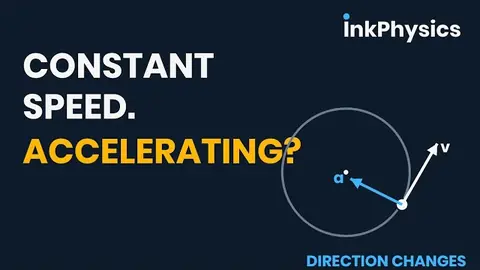
An object circling at constant speed is accelerating, continuously, because velocity is a vector and its direction changes at every instant. The acceleration points to the centre of the circle, always at right angles to the velocity; that perpendicularity is how the direction can change while the speed does not.

Describe the drawing
The dot goes round at constant speed, and the cyan velocity arrow never changes length; but it never stops changing direction, so the velocity is changing and there must be an acceleration. The coral arrow shows it: aimed at the centre at every instant. Restyled, the same motion is a satellite held by gravity or a charge held by a magnetic field.
By Newton's second law, a centre-pointing acceleration demands a centre-pointing resultant force, the centripetal force. Nothing flings you outward. Take a corner in a car and your body continues in a straight line (Newton's first law) while the car turns underneath you; the sensation of being thrown outward is the car door arriving to push you inward. Remove the centripetal force and the object does not fly radially away. It departs along the tangent.
Radian measure and angular speed
Circles are easier in angle language. One radian is the angle whose arc length equals the radius, which gives θ = s/r and makes a full circle 2π radians.
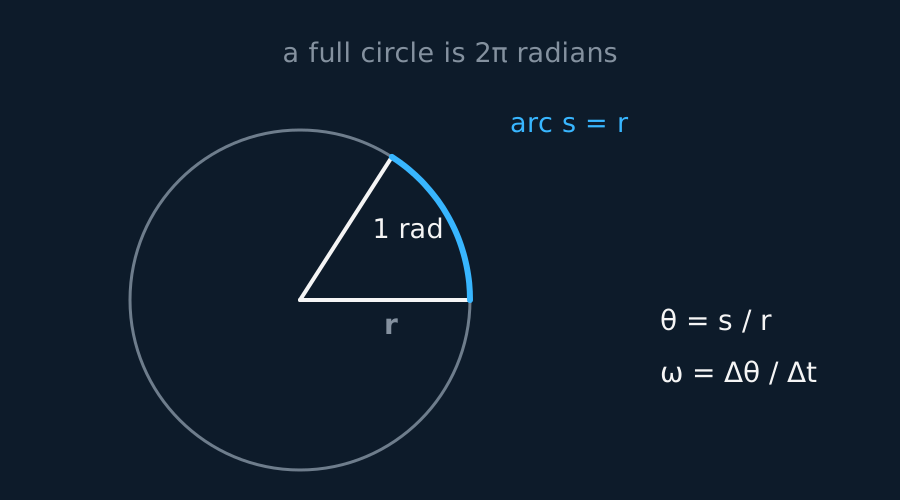
The angular speed ω is the angle swept per second, in rad s−1, and it links to everything else through
Direction of angular velocity is not considered at this level, so ω here means a magnitude. Keep the calculator in radian mode for the whole unit; in degree mode every trigonometric evaluation in this unit gives a wrong value.
WORKED EXAMPLE
Angular speed, linear speed and acceleration
A fairground ride carries riders in a circle of radius 6.0 m, completing each revolution in 4.0 s. Find the angular speed, the linear speed and the centripetal acceleration.
ω = 2π/T = 2π/4.0 = 1.6 rad s−1.
v = ωr = 1.57 × 6.0 = 9.4 m s−1.
a = ω2r = 1.572 × 6.0 = 15 m s−2, about 1.5g, aimed at the centre. Work out ω, then v, then a; that order suits most circular-motion calculations.
The vector triangle behind the acceleration
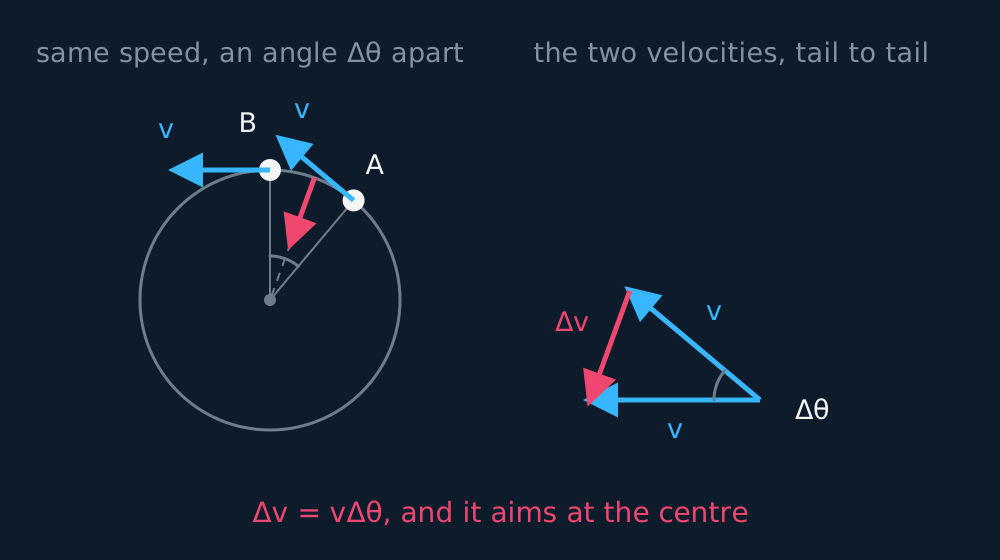
The centripetal acceleration follows from the velocity vector alone, in an argument short enough to reproduce under exam conditions. Follow the object from one point on the circle to another a small angle Δθ later. The speed never changes, so the two velocity vectors have the same length. Each is tangent to the circle, so swinging the radius through Δθ swings the velocity through the same Δθ.
Describe the drawing
Left, a circle with two positions A and B a small angle apart, each carrying a tangential velocity arrow of the same length, and a coral arrow at the middle of the arc pointing along a dashed line to the centre. Right, the two velocities redrawn from a common tail with the coral change-in-velocity arrow closing the triangle between their tips.
Redraw the two velocities from a common tail and the change in velocity is the third side of the triangle, running from the tip of the first to the tip of the second. Two sides of length v with Δθ between them make an isosceles triangle, so for a small angle the closing side is a short arc of a circle of radius v, and its length is Δv = vΔθ.
The direction follows from the symmetry. The two velocities sit symmetrically about the middle of the arc, so their difference lies exactly along the radius there, pointing inwards. Shrink Δθ and that midpoint closes on the object itself, which is the reason the acceleration at any instant is directed at the centre. The coral arrow on the left of the figure is that same Δv carried back to the circle, and the dashed line shows it running through the centre.
The time to sweep Δθ is Δt = Δθ/ω, straight from the definition of angular speed, so
Δθ cancels, so the result does not depend on the size of the step taken.
Acceleration and force
One substitution each way turns a = vω into the pair the questions use. Put ω = v/r into it for the first form and v = ωr for the second:
Multiply by mass for the force:
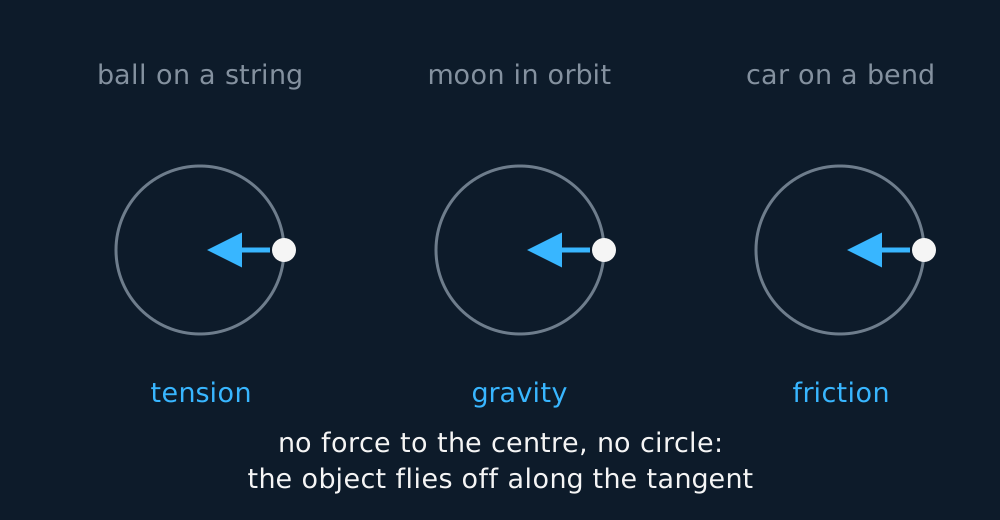
Centripetal force is never a new force. The term names the role played by a real force: tension, gravity, friction or a normal contact force, and sometimes several acting together. “What provides the centripetal force?” requires one of those to be named; answering “centripetal force” restates the question.
GUIDED PRACTICE
The spin cycle
A washing machine drum of radius 0.25 m spins at 1200 revolutions per minute. Convert to an angular speed, then find the centripetal acceleration at the drum wall.
Show the working
1200 rpm means 20 revolutions per second, so ω = 20 × 2π = 126 rad s−1.
a = ω2r = 1262 × 0.25 = 3.9 × 10³ m s−2, about 400g. The drum wall provides that force on the clothes; the water at the holes has nothing to push on it, so it leaves. Spin-drying works because the water is not made to follow the circular path.
INDEPENDENT PRACTICE
The slowest loop
A ball on a string is whirled in a vertical circle of radius 0.80 m. Find the minimum speed at the top for the string to stay taut.
Show the working
At the top, weight and tension both point downwards and together supply the centripetal force. The minimum case has the tension at zero and the weight supplying all of it, so mg = mv2/r.
v = the square root of gr = the square root of 9.81 × 0.80 = 2.8 m s−1. The mass cancels, so the threshold speed is the same for any bob on a 0.80 m string.
ASSESSMENT FOCUS
- For “explain why the object accelerates at constant speed”, three short sentences do it. Velocity is a vector. Its direction changes. A changing velocity is an acceleration.
- Name the provider. Tension, gravity, friction or a normal reaction supplies the centripetal force; writing “centripetal force” as the provider names the job rather than the force.
- Use radian mode. The formulas and the data sheet assume radians, and evaluating cos ωt in degree mode gives a wrong value.
- Lose the centripetal force and the object leaves along the tangent, never radially outward.
- Choose the convenient form. Use v²/r when the speed is given, ω²r when the period or frequency is, via ω = 2πf = 2π/T.
- Edexcel asks you to derive a = v²/r from a vector diagram, and the derivation has three steps. Equal-length velocity vectors because the speed is constant, Δv = vΔθ from the isosceles triangle with Δv aimed at the centre, then divide by Δt = Δθ/ω. The other boards quote the result and examine its use; the same triangle also answers why the acceleration points inwards.
CHECK YOURSELF
A 900 kg car takes a bend of radius 50 m at a steady 15 m s−1. Find the centripetal force required, state what provides it, and explain what happens if the road cannot supply that much.
Show a hint
One formula, then think about which real force supplies it on a flat road.
Show the answer
= 900 × 152 / 50 = 4050 N, directed towards the bend's centre.
On a flat road the provider is friction between the tyres and the surface.
If friction cannot reach 4050 N, on ice say, the car cannot hold that circle. It follows a straighter path and drifts wide along a tangent, which is a skid.
Circular motion is accelerated motion, aimed at the centre.
Something real has to supply the force.
WORKBOOK
Printable practice for this topic: original exam-style questions with room to work, and a fully worked answer book. Free to use; please do not redistribute or sell.
Or read them with their mark schemes on the circular motion questions page.
WHERE TO GO NEXT
- Trigonometry and resolving vectors is the maths this lesson leans on, worked through step by step.
USED LATER IN
CHECK YOUR PROGRESS
Rate how confident you feel with each objective for this lesson. Ratings are saved in this browser, on this device, unless you sign in.
- Explain why constant-speed circular motion is accelerated motion, and why it needs a centripetal force.
- Work in radians, with ω = v/r = 2πf.
- Derive a = v²/r from a vector triangle, and see where its inward direction comes from.
- Apply a = v²/r = ω²r and F = mv²/r = mω²r, and name the real force supplying it each time.
Open the full revision checklist to track your progress across the whole unit.