Physics › Magnetic fields › Magnetic flux and flux linkage
Magnetic flux and flux linkage
Magnetic flux is the field passing through an area, Φ = BA in webers, and flux linkage NΦ counts that flux once for every turn of the coil. Tilt the coil and only the field component along its normal counts, giving NΦ = BAN cos θ, with θ measured to the normal. A search coil and an oscilloscope can confirm the cos θ dependence.
Choose your exam board to show the notes and questions relevant to your specification. You can change this setting at any time, and content for other boards remains available.
Builds on Magnetic flux density and the force on a wire and Scalars and vectors.
IN THIS TOPIC
- Use Φ = BA for an area normal to the field, in webers.
- Use flux linkage NΦ, and NΦ = BANcosθ for a rotated coil, with θ to the normal.
- Describe the required-practical investigation with a search coil and oscilloscope.
COMMON MISCONCEPTION
θ is the angle between the field and the coil.
θ in Φ = BA cos θ is the angle between the field and the normal to the coil's plane, not the plane itself; field straight through the coil gives θ = 0 and maximum flux.
Flux: field through an area
Magnetic flux measures the amount of field passing through a chosen area. The magnetic flux through an area A held face-on to a field B, so that B lies along the area's normal, is
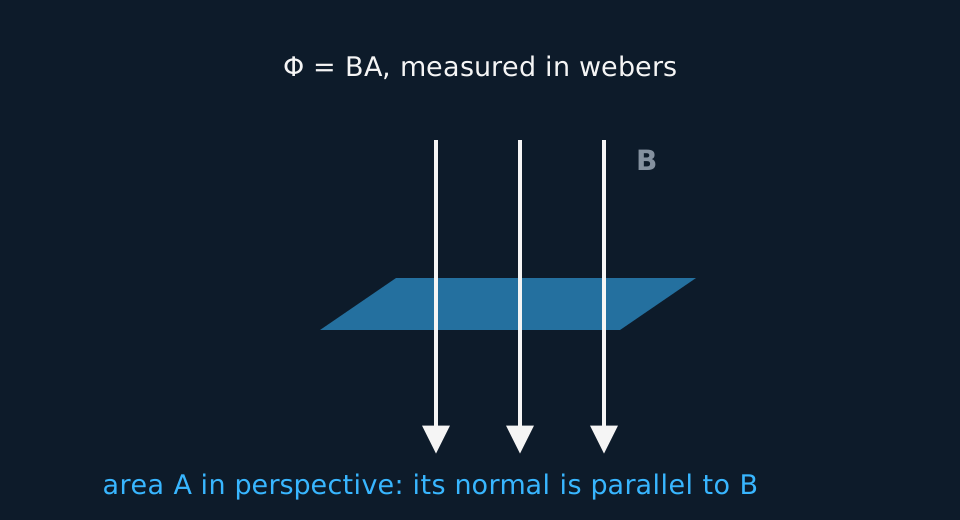
measured in webers, where one weber is one tesla multiplied by one square metre. Flux density B is therefore flux per unit area, in webers per square metre, which is what a tesla is.
WORKED EXAMPLE
Flux, then linkage
A 200-turn coil of area 3.0 × 10⁻³ m2 sits face-on to a 0.15 T field. Find the flux through one turn and the flux linkage.
Face-on means the normal lies along the field, so the cosine is 1 and Φ = BA = 0.15 × 3.0 × 10−3 = 4.5 × 10⁻⁴ Wb.
Linkage counts every turn, so NΦ = 200 × 4.5 × 10−4 = 0.090 Wb turns.
The two quantities differ only by the number of turns. Electromagnetic induction depends on the flux linkage, because each turn contributes its own share of the induced emf.
Linkage, and the tilt
A coil of N turns threads the same flux N times over, and the quantity driving every result in electromagnetic induction is the flux linkage, NΦ. Tilt the coil and only the component of B along the coil's normal still counts.
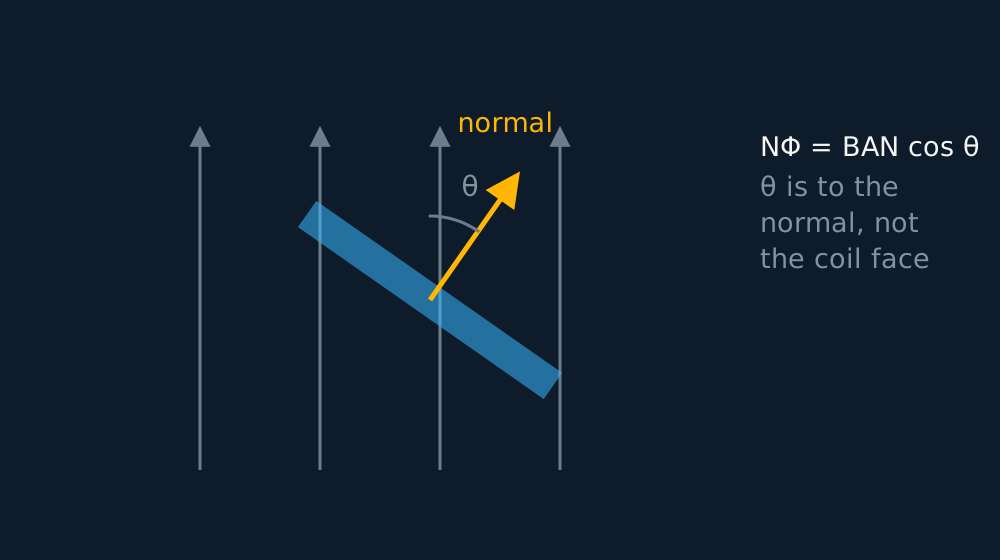
where θ is the angle between B and the normal to the coil's plane. Face-on means θ = 0 and full linkage; edge-on means θ = 90° and zero linkage, even though the coil's plane then lies along the field. Check any answer against those two limits.
Watch Magnetic flux: get the angle right on the InkPhysics YouTube channel
GUIDED PRACTICE
Flux linkage at a thirty-degree tilt
The same coil is tilted so that its normal makes 30° with the field. Find the new flux linkage, and check it against the two limits.
Show the working
NΦ = BANcos θ = 0.090 × cos 30° = 0.078 Wb turns.
The limits bracket the answer: face-on gives 0.090 Wb turns and edge-on gives zero, so a thirty-degree tilt should reduce the linkage only slightly, and cos 30° = 0.87 does so. Using sin θ instead would give 0.045 Wb turns, which fails that check.
Required practical 11, the search coil
The eleventh required practical measures how flux linkage depends on orientation, using a search coil, a small many-turned coil on a handle, connected to an oscilloscope. With the coil in an alternating field, the changing linkage induces an alternating pd whose amplitude on the screen is proportional to the flux linkage through the coil. Rotate the search coil in steps, read the amplitude at each angle, and a plot of amplitude against cos θ is a straight line, confirming the cosine relation. The law of induction on which the measurement depends is covered in the next lesson.
ASSESSMENT FOCUS
- Φ = BA needs B along the normal. For anything else go straight to BANcosθ, and say what θ is measured to.
- Use the limits as a check: face-on, θ = 0, gives maximum linkage; edge-on, θ = 90° with the field lying in the coil's plane, gives zero. Quote them in an explanation.
- Give the units: flux in webers, flux linkage in weber-turns, and one tesla is one weber per square metre.
- Read “rotated by” carefully. A coil rotated 30° from face-on has θ = 30°, while one rotated 30° from edge-on has θ = 60°. Draw the normal before substituting.
- In the practical, the oscilloscope amplitude is proportional to the flux linkage. Plot amplitude against cos θ and state that a straight line through the origin confirms the relationship.
CHECK YOURSELF
A 500-turn coil of area 2.0 × 10⁻³ m² sits in a 0.15 T field with its normal at 60° to the field. Find the flux linkage, and state what it becomes face-on.
Show a hint
BANcosθ, with θ to the normal; then set θ to zero.
Show the answer
= 0.15 × 2.0 × 10−3 × 500 × cos 60° = 0.075 Wb turns.
Face-on, cosθ = 1, so the linkage doubles to 0.15 Wb turns.
Edge-on the linkage would be zero. Checking an answer against those two limits identifies a misread angle.
Flux is the field through an area, Φ = BA; flux linkage multiplies it by the number of turns; and θ in NΦ = BAN cos θ is measured to the normal.
WORKBOOK
Printable practice for this topic: original exam-style questions with room to work, and a fully worked answer book. Free to use; please do not redistribute or sell.
Or read them with their mark schemes on the magnetic flux and flux linkage questions page.
WHERE TO GO NEXT
- Required practical 11: flux linkage and a search coil puts this topic in the lab, and the written papers ask about it.
- Trigonometry and resolving vectors is the maths this lesson leans on, worked through step by step.
CHECK YOUR PROGRESS
Rate how confident you feel with each objective for this lesson. Ratings are saved in this browser, on this device, unless you sign in.
- Use Φ = BA for an area normal to the field, in webers.
- Use flux linkage NΦ, and NΦ = BANcosθ for a rotated coil, with θ to the normal.
- Describe the required-practical investigation with a search coil and oscilloscope.
Open the full revision checklist to track your progress across the whole unit.