Physics › Mechanics › Scalars and vectors
Scalars and vectors
A scalar has size alone, while a vector has size and direction, and two vectors add tip to tail rather than as plain numbers. Resolving runs that backwards, splitting one vector into perpendicular components; weight on a slope is the case exams return to. Three forces in equilibrium close the triangle.
Choose your exam board to show the notes and questions relevant to your specification. You can change this setting at any time, and content for other boards remains available.
The maths behind it: Vectors in two dimensions on InkMaths.
IN THIS TOPIC
- Classify quantities as scalars or vectors, using the standard paired examples.
- Add two perpendicular vectors by calculation, and any other pair by scale drawing.
- Subtract one coplanar vector from another by reversing it and adding, and use that to find a change in a vector quantity.
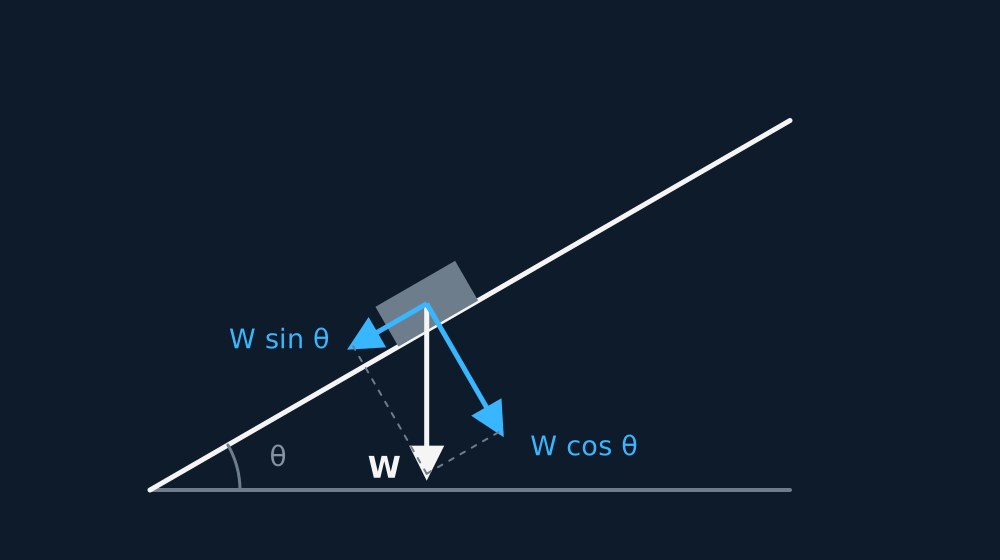
- Resolve a vector into two perpendicular components, including weight on an inclined plane.
- State and use the equilibrium condition for two or three coplanar forces acting at a point.
COMMON MISCONCEPTION
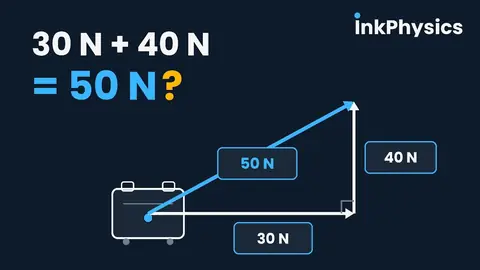
Adding forces means adding the numbers.
Forces are vectors, so magnitudes cannot simply be added: the resultant depends on the angle between them. Only forces, or components, along the same line add as plain numbers.
Two kinds of quantity
A scalar has size only. A vector has size and direction, and the direction affects the result of every calculation the vector enters. Learn the standard pairs cold. Distance is a scalar and displacement its vector partner, and speed pairs with velocity the same way. Mass is a scalar and weight a vector, but they are different quantities rather than two versions of one: weight is the gravitational force on the mass. Force and acceleration are vectors through and through.
The distinction matters as soon as two quantities are combined. Two 5 N forces can add to 10 N, to zero, or to anything between, depending entirely on their directions. Adding the numbers is only ever the special case of forces pointing the same way.
Adding and subtracting vectors
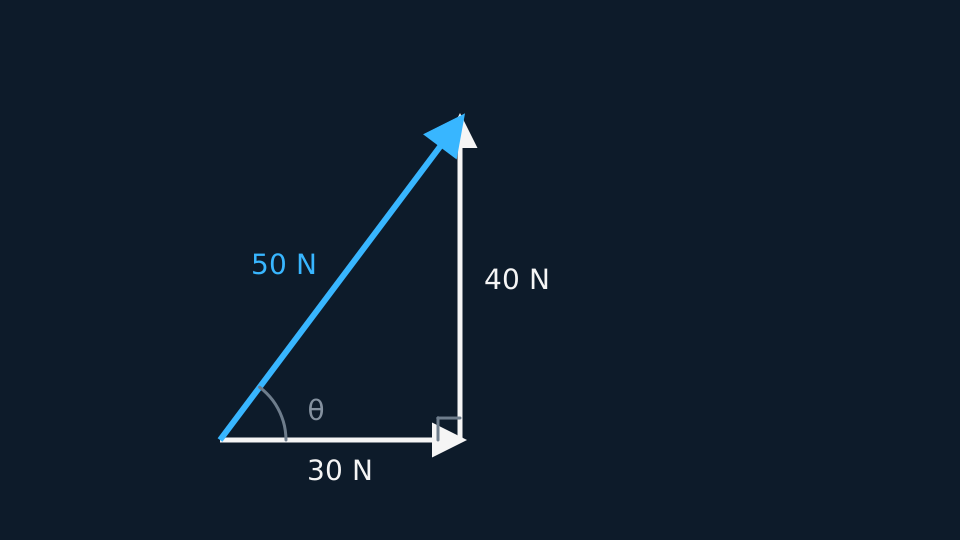
Vectors add tip to tail. Draw the first, start the second from its head, and the resultant runs from the very start to the very end. For two vectors at right angles, Pythagoras gives the magnitude and trigonometry gives the direction.
For vectors at other angles the expected method is a scale drawing. Choose a scale, draw tip to tail carefully, and measure the resultant's length and angle with a ruler and a protractor. Write the scale on the diagram; it is part of the answer.
WORKED EXAMPLE
Adding two perpendicular velocities
A plane flies at 60 m s−1 due north while a crosswind blows it at 25 m s−1 due east. Find the plane's resultant velocity.
Perpendicular vectors mean Pythagoras for the magnitude. The resultant is the square root of 602 + 252 = the square root of 4225 = 65 m s−1.
The direction needs a line of its own. tan θ = 25/60, so θ = 23° east of north. A vector answer must give both the magnitude and the direction.
Check it lands sensibly. The resultant beats either part on its own but falls short of their plain sum, which is exactly where a tip-to-tail triangle has to put it.
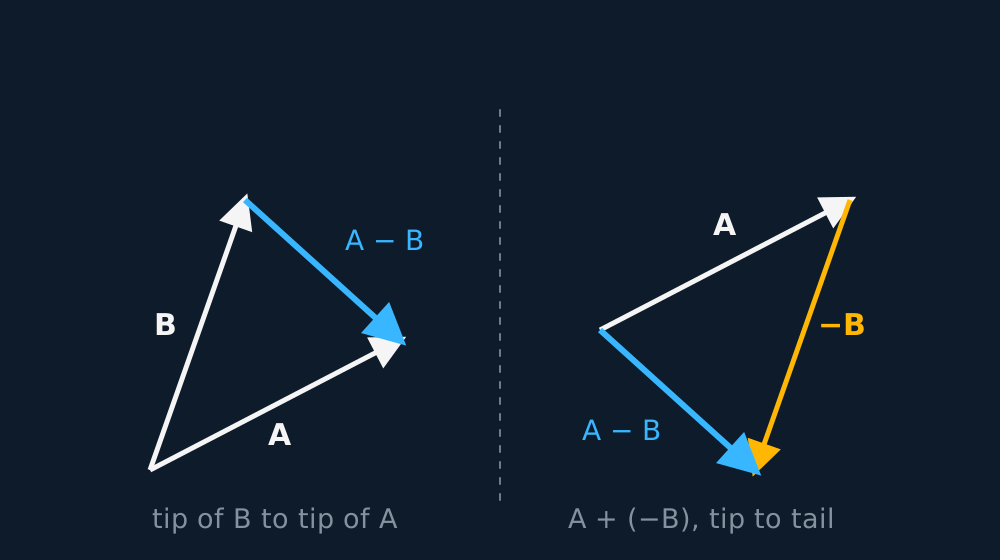
Subtraction needs no new rule, only a reversal. The negative of a vector, written −B, has the same magnitude as B and points the opposite way, so A − B means A + (−B). Draw A, turn B round, and join the two tip to tail exactly as you would for a sum.
One shortcut is worth knowing alongside it. Draw A and B from the same starting point, and A − B is the vector running from the tip of B to the tip of A. Both routes give the identical arrow, so use whichever the diagram in front of you already has.
Every change in a vector quantity is a subtraction of this kind. A change in velocity is with both treated as vectors, which is why a ball rebounding off a wall at its original speed has a velocity change that is not zero. Reverse u, add, and the change comes out at twice the speed, directed away from the wall. The same move gives the change in momentum in a collision, and the velocity of one object relative to another, which is one velocity minus the other.
Resolving into components
Addition run backwards is resolution. Any vector can be swapped for two components at right angles, and the pair behaves identically to the original in every calculation. A vector F at angle θ to a chosen axis splits into F cos θ along that axis and F sin θ perpendicular to it.
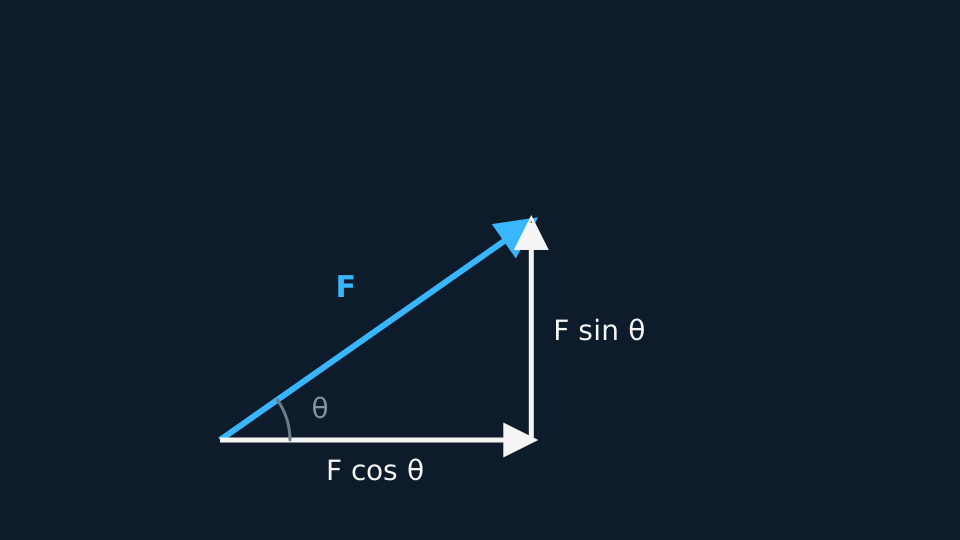
The exam's favourite setting is the inclined plane. Resolve the weight along and perpendicular to the slope, never horizontally and vertically. W sin θ acts down the slope and drives the block. W cos θ presses into the surface, and that is the component the normal contact force has to match.
GUIDED PRACTICE
Resolve a launch velocity
A jet leaves the runway at 250 m s−1, climbing at 60° above the horizontal. Decide which component takes the cosine, then find both components.
Show the working
The angle is measured from the horizontal, so the horizontal component takes the cosine. 250 cos 60° = 125 m s−1.
Vertically, 250 sin 60° = 217 m s−1. The component adjacent to the angle takes the cosine, so identify which direction the angle is measured from before resolving.
Equilibrium at a point
Two or three coplanar forces acting at a point are in equilibrium when their resultant is zero, and equilibrium means the object is at rest or moving at constant velocity. Both cases satisfy the same condition of zero resultant.

Describe the drawing
Three forces act on one point, left. To test for equilibrium, walk them head to tail: draw the first, start the second from its head, the third from that one's head. Here the walk arrives exactly back where it began, the triangle closes, and that closure is the statement that the forces balance. If the walk had fallen short or overshot, the gap would have been the resultant.
Zero resultant has a graphical signature. Drawn tip to tail, forces in equilibrium form a closed triangle. Problems yield to either route, resolving in two perpendicular directions and setting each sum to zero, or drawing the closed triangle and doing trigonometry on it. Pick whichever makes the angles you were given easy.
INDEPENDENT PRACTICE
A hanging mass on two strings
A 3.0 kg lamp hangs from two identical strings, each at 40° above the horizontal. Find the tension in each string, resolving vertically. Work it through.
Show the working
The weight is 3.0 × 9.81 = 29.4 N. Each string supplies a vertical component T sin 40°, and there are two of them.
Equilibrium vertically gives 2T sin 40° = 29.4, so T = 29.4/(2 × 0.643) = 23 N.
Each tension exceeds half the weight, because only part of each string's pull acts upward. As the strings are made flatter, the sine of the angle falls, so the tension needed rises without limit as the angle approaches zero.
ASSESSMENT FOCUS
- “State whether X is a scalar or a vector, and explain the difference” is a routine opener: a vector has direction as well as magnitude.
- Calculations are limited to perpendicular pairs; anything else is a scale drawing. If angles other than 90° appear and no drawing is asked for, resolve first.
- Subtraction is asked for as often as addition, and it is always the same instruction: reverse the second vector and add it. A “change in velocity” or “change in momentum” question is a vector subtraction, so a straight rebound gives twice the speed and not zero.
- On a slope, resolve along and perpendicular to the slope. Horizontal and vertical components give the normal contact force a projection in both directions and lengthen the algebra.
- The component adjacent to the angle takes cos, the opposite takes sin. Check for a sin/cos swap with a limiting case. At θ = 0 the along-slope component W sin θ ought to vanish, and it does.
- “Constant velocity” in a question means equilibrium: resultant zero. Treat it exactly as you would “at rest”.
CHECK YOURSELF
Forces of 30 N and 40 N act on a point at right angles to each other. Find the magnitude of the resultant and the angle it makes with the 30 N force.
Show a hint
Tip to tail, then Pythagoras for the size and tangent for the angle.
Show the answer
For the magnitude, , and the square root gives 50 N.
For the direction, tan θ = 40/30, so θ = 53° to the 30 N force. These are the sides of a 3-4-5 triangle scaled by ten.
Vectors add tip to tail.
Only their components add as plain numbers.
Equilibrium closes the triangle.
WORKBOOK
Printable practice for this topic: original exam-style questions with room to work, and a fully worked answer book. Free to use; please do not redistribute or sell.
Or read them with their mark schemes on the scalars and vectors questions page.
WHERE TO GO NEXT
- Trigonometry and resolving vectors is the maths this lesson leans on, worked through step by step.
USED LATER IN
CHECK YOUR PROGRESS
Rate how confident you feel with each objective for this lesson. Ratings are saved in this browser, on this device, unless you sign in.
- Classify quantities as scalars or vectors, using the standard paired examples.
- Add two perpendicular vectors by calculation, and any other pair by scale drawing.
- Subtract one coplanar vector from another by reversing it and adding, and use that to find a change in a vector quantity.
- Resolve a vector into two perpendicular components, including weight on an inclined plane.
- State and use the equilibrium condition for two or three coplanar forces acting at a point.
Open the full revision checklist to track your progress across the whole unit.