Physics › Mechanics › Conservation of energy
Conservation of energy
In a closed system energy is only transferred between stores, and mechanics runs almost entirely on kinetic and gravitational potential energy. Both equations come from the work done by a force: ½mv² from the equations of motion, and mgΔh from lifting a mass at steady speed. A real system needs a third term, the work done against friction and drag.
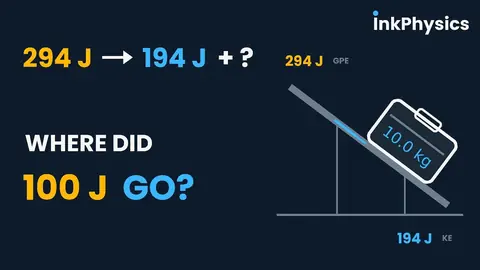
Choose your exam board to show the notes and questions relevant to your specification. You can change this setting at any time, and content for other boards remains available.
Builds on Work, energy and power.
IN THIS TOPIC
- State the principle of conservation of energy and use it as an energy balance.
- Calculate kinetic energy and changes in gravitational potential energy.
- Derive ΔEp = mgΔh from W = Fs, and Ek = ½mv2 from the equations of motion.
- Balance energy transfers that include work done against friction or drag.
COMMON MISCONCEPTION
Energy gets used up.
Energy is never used up; it is transferred, usually ending as internal energy spread into the surroundings. Dissipated energy is not destroyed, just no longer usefully collected.
The principle, and the two big stores
Energy cannot be created or destroyed. In a closed system, the total energy remains constant as energy is transferred between stores. If resistive forces reduce the mechanical energy, an equal amount is transferred to the internal energy of the objects and surroundings. Write the initial and final energy terms explicitly before substituting values.
Mechanics runs almost entirely on two stores. The first is kinetic energy, the energy of motion.
The second is the change in gravitational potential energy when a mass moves through a height.
Kinetic energy depends on the square of the speed, so doubling the speed multiplies the kinetic energy by four. Against a constant braking force, that quadruples the braking distance.
Where the two formulas come from
Both equations follow from the work done by a force, . Near Earth's surface, . For an object accelerated from rest by a constant resultant force, , and give . Both derivations are short enough to reproduce rather than recall.
Take the potential energy first. To raise a mass m through a height Δh without giving it any speed, you pull upward with a force equal to its weight, mg, and that force acts along the displacement, so W = Fs becomes W = mg × Δh with no angle to worry about. The work you put in is held in the gravitational field and returned in full if the mass is released, so the store gains exactly the work done, . Treating g as a single number requires the gravitational field to be uniform over the height climbed. Near the Earth's surface it is, and over the height of a mountain it is not quite.
Kinetic energy needs one extra ingredient, the equations of motion. Push a mass m from rest with a constant resultant force F through a distance s. The work done on it is , and Newton's second law turns the F into ma, so W = mas. Now bring in with u = 0, which leaves , so the product as on its own is . Put that back in place of as, and the work done comes out as W = m × ½v2 = ½mv2.
No work was done against gravity or against resistive forces, so all of that work went into the motion. The energy a mass m carries by virtue of moving at speed v is therefore . The ½ comes from the 2 in .
Frictionless exchanges
With no resistive forces, energy transfers between the two stores. A pendulum converts potential to kinetic on the way down and back again on the way up; a thrown ball does the same in one exchange.

Describe the drawing
First pass, no friction: the pendulum swings and kinetic and potential energy slosh back and forth, always summing to the dashed line. Second pass, a little friction: every swing leaks a sliver of height into the grey heat bar, the swing shrinks, but the three bars together still reach the line every instant. Energy is never lost, only moved somewhere less useful.
That exchange opens a fast route through problems which would be tedious with forces. Equate mgΔh to ½mv2 and the speeds and heights follow with no force diagram at all. The mass usually cancels, so a heavy pendulum and a light one released from the same height reach the bottom at identical speed.
WORKED EXAMPLE
A pendulum's speed at the bottom
A pendulum bob is pulled aside until it sits 0.20 m higher than its lowest point, then released. Find its speed at the bottom.
Take the energy route. The tension is always perpendicular to the motion and does no work, so every joule of gravitational potential energy becomes kinetic energy.
mgh = ½mv2, and the mass cancels, leaving v = the square root of 2 × 9.81 × 0.20 = 2.0 m s−1.
No mass was given because the mass cancels.
GUIDED PRACTICE
Thrown from a cliff, any direction
A ball is thrown at 12 m s−1 from the top of a 15 m cliff. Using energy conservation, find its speed just before landing, and say why the throwing angle never entered.
Show the working
½mv2 = ½mu2 + mgh, and the mass cancels, leaving v2 = 122 + 2 × 9.81 × 15 = 438.
v = 21 m s−1. Energy is a scalar, so the drop in height fixes the gain in speed whatever direction the throw took. Obtaining the same result from projectile SUVAT would require the launch angle.
When friction dissipates energy
In a real system some mechanical energy is transferred to internal energy by work done against resistive forces, warming the surfaces and the air. Nothing is destroyed, so the energy balance then has three terms.
Watch Using energy balance to find friction, a worked question on the InkPhysics YouTube channel
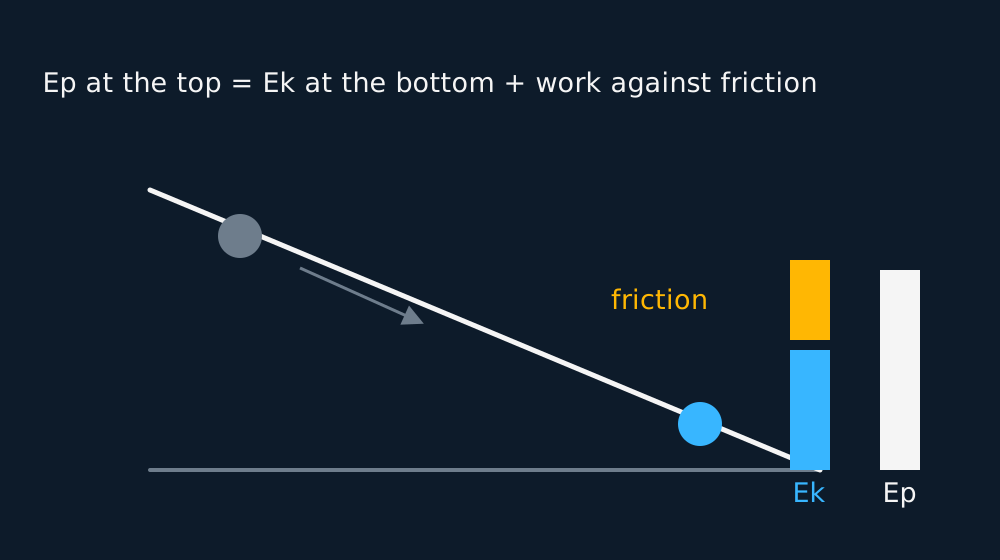
Energy at the start equals energy at the end plus the work done against the resistive forces. Questions supply two of the three terms and ask for the third, or supply all three and ask whether they balance. Write the stores at the start and at the end; the difference is the work done against resistance.
INDEPENDENT PRACTICE
A braking distance from energy
A 1000 kg car at 25 m s−1 brakes with a constant resistive force of 6.0 kN. Find the stopping distance using the energy route.
Show the working
Work done against the braking force takes all of the kinetic energy, so ½mv2 = Fd.
d = (½ × 1000 × 252)/6000 = 312 500/6000 = 52 m.
Because kinetic energy is proportional to v2, doubling the speed quadruples the initial kinetic energy and, with the same constant braking force, quadruples the stopping distance. Motorway crashes differ from town crashes for exactly that reason.
ASSESSMENT FOCUS
- Open energy questions with the balance: energy at the start = energy at the end + work done against resistive forces. Write it before substituting any numbers.
- ΔEp uses the vertical height change. On a slope that is the vertical drop, not the distance travelled along the surface.
- “Where did the energy go?” has one preferred answer: it was transferred to internal energy of the object and its surroundings by the resistive force. “Lost as heat” is tolerated. “Lost” on its own is not.
- The mass often cancels in a pure Ep-to-Ek exchange. Asked why two different masses land at the same speed, that cancellation is the answer.
- CIE examines both derivations by name. For ΔEp, lift at constant speed so the force is mg and quote W = Fs. For Ek, start from W = Fs, put F = ma, then use v2 = u2 + 2as with u = 0 to replace as by ½v2.
CHECK YOURSELF
A child of mass 30 kg starts from rest at the top of a slide 2.5 m high and reaches the bottom at 5.0 m s−1. How much energy was transferred to the surroundings by friction?
Show a hint
Write the energy balance out. Potential in, kinetic out, and friction takes the difference.
Show the answer
Potential energy given up is = 30 × 9.81 × 2.5 = 736 J.
Kinetic energy gained is = ½ × 30 × 5.02 = 375 J.
The energy has to balance, so friction accounted for 736 − 375 = 361 J, which is 360 J to two significant figures. It is now internal energy in the slide, the child and the air.
Energy cannot be created or destroyed; it can only be transferred between stores.
WORKBOOK
Printable practice for this topic: original exam-style questions with room to work, and a fully worked answer book. Free to use; please do not redistribute or sell.
Or read them with their mark schemes on the conservation of energy questions page.
CHECK YOUR PROGRESS
Rate how confident you feel with each objective for this lesson. Ratings are saved in this browser, on this device, unless you sign in.
- State the principle of conservation of energy and use it as an energy balance.
- Calculate kinetic energy and changes in gravitational potential energy.
- Derive ΔEp = mgΔh from W = Fs, and Ek = ½mv2 from the equations of motion.
- Balance energy transfers that include work done against friction or drag.
Open the full revision checklist to track your progress across the whole unit.