Physics › Nuclear physics › Alpha, beta and gamma radiation
Alpha, beta and gamma radiation
Absorption tells the three radiations apart: paper stops alpha, a few millimetres of aluminium stop beta, and thick lead only attenuates gamma. Composition, mass and charge describe each one, and penetration decides its uses and its hazards. Required practical 12 tests I = k/x² for gamma on count rates corrected for background.
Choose your exam board to show the notes and questions relevant to your specification. You can change this setting at any time, and content for other boards remains available.
Watch Alpha, beta and gamma radiation on the InkPhysics YouTube channel
Rutherford scattering and the nuclear atom, part 2 of 2. Part 1 is Rutherford scattering and the nuclear model.
Builds on Rutherford scattering and the nuclear model and Stable and unstable nuclei.
IN THIS TOPIC
- Identify alpha, beta and gamma from a simple absorption experiment, and give the composition, mass and charge of each, both signs of beta included.
- Match each radiation to its applications and to the hazard it presents.
- Use the inverse-square law for gamma with corrected count rates, as in required practical 12.
COMMON MISCONCEPTION
Doubling your distance from a gamma source halves the intensity.
Doubling the distance quarters gamma intensity, not halves it: the photons spread over a sphere, so I = k/x². Halving would be a 1/x law, and the inverse-square practical exists to show the difference, once background has been subtracted.
Three radiations, three absorption tests
Part 1 put a tiny, positive nucleus at the centre of the atom; not every nucleus is stable, and the unstable ones emit three kinds of radiation. A simple absorption experiment names them. Put absorbers between source and detector in turn. Whatever a sheet of paper stops is alpha; whatever paper passes but a few millimetres of aluminium stops is beta; whatever passes both and only thins through thick lead is gamma.
| α | β⁻ | β⁺ | γ | |
|---|---|---|---|---|
| composition | 2 protons and 2 neutrons: a helium nucleus | an electron | a positron | a photon, with no rest mass |
| mass | 4u | u/1840 | u/1840 | zero |
| charge | +2e | −1e | +1e | 0 |
| stopped by | a sheet of paper | a few mm of aluminium | a few mm of aluminium, if it survives that far | thick lead, attenuating rather than halting it |
| ionising power | intense | moderate | moderate | weak |
Read the mass row in atomic mass units, u being 1.66 × 10⁻²⁷ kg, near enough the mass of one nucleon. An alpha is 4u, or 6.6 × 10⁻²⁷ kg. A beta particle of either sign is about u/1840, or 9.1 × 10⁻³¹ kg, some seven thousand times lighter than an alpha. A gamma photon has no mass at all, and no charge either.
Beta comes in two signs, which is why the table carries two columns for it. A β− particle is a fast electron and a β+ particle is a fast positron, identical in mass and opposite in charge, so the absorption test cannot tell them apart: a few millimetres of aluminium stops either. A magnetic field can, since it bends them opposite ways. In practice a positron gets nowhere at all in matter. Within a millimetre or two it meets an electron and annihilates, and what leaves the material is a pair of gamma photons, which is the basis of the PET scanner in the medical physics unit.
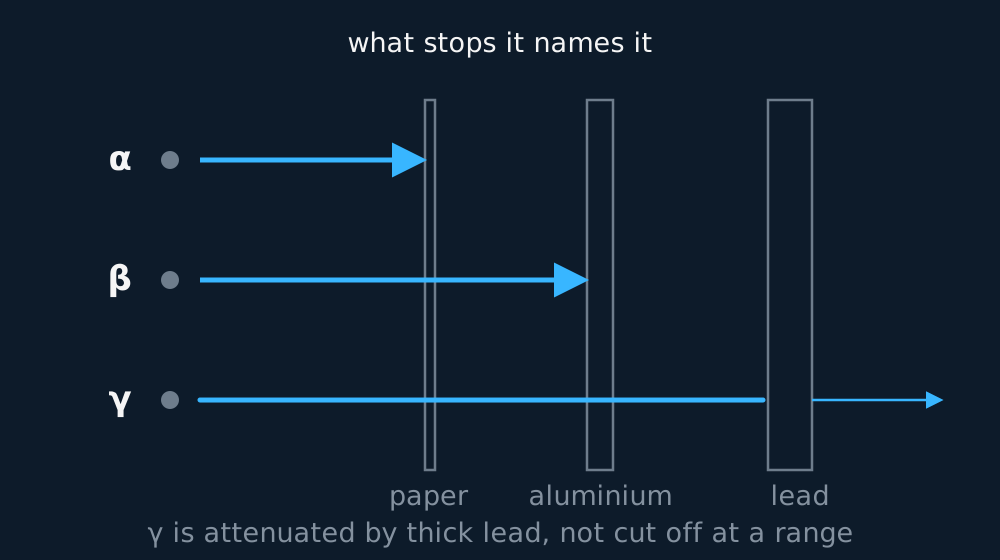
Penetration and ionisation trade off against each other. Alpha is heavy, doubly charged and slow, so it ionises intensely and exhausts itself within a few centimetres of air. Outside the body that usually makes it a low hazard to intact skin, though eyes and open wounds still need care; swallowed or inhaled, an alpha emitter delivers all of that intense ionisation directly into living tissue, so internal contamination is treated as a serious hazard, with the actual risk depending on the activity, the energy and where the material lodges. Gamma penetrates furthest and ionises least.
Industry uses that range of penetrations. A beta source above a rolling sheet of paper or aluminium foil monitors the thickness from the count rate below, while steel plate needs gamma to get through at all.
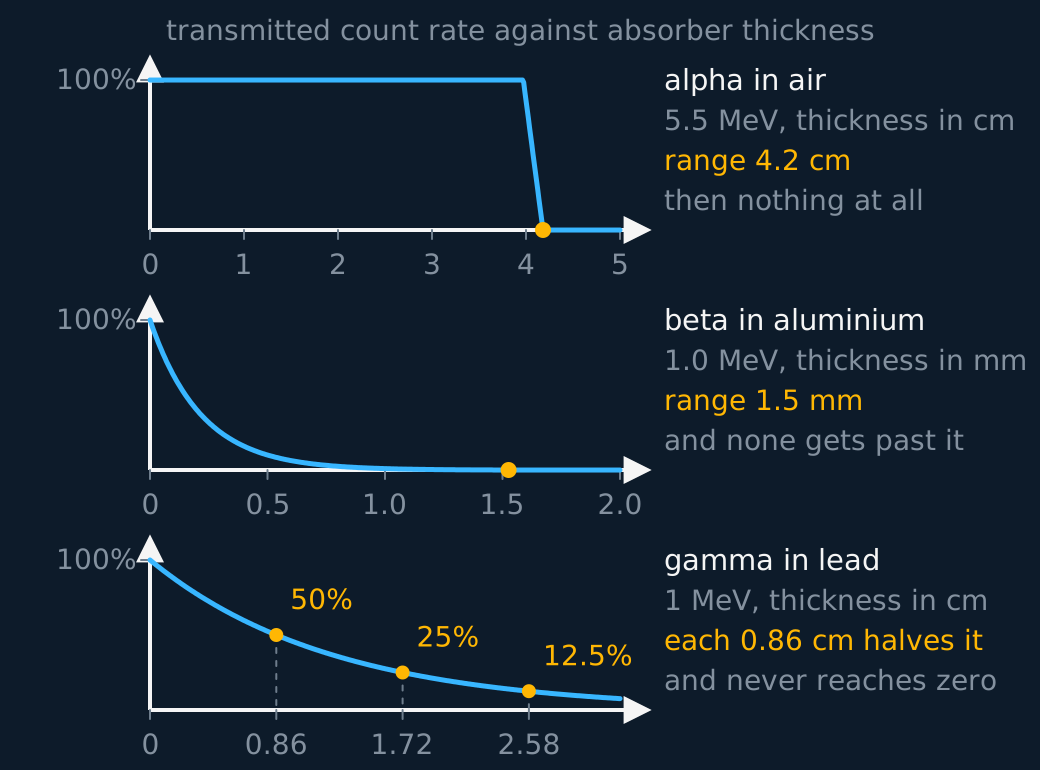
Gamma also behaves differently in kind. Alpha and beta have a definite range and simply run out, while a gamma beam is attenuated, its intensity falling by a fixed fraction for each further thickness of absorber. Enough lead brings it down to whatever level a job requires, and no single thickness switches it off cleanly.
GUIDED PRACTICE
Name that radiation
A source's count rate is unchanged by a sheet of paper but falls almost to background behind 3 mm of aluminium. Identify the radiation, reasoning from the absorption tests.
Show the working
Paper stops alpha, so the unchanged rate through paper rules alpha out. Aluminium of a few millimetres stops beta but barely dents gamma.
The near-total loss behind aluminium therefore identifies beta. Absorber questions work by elimination, with each absorber answering one yes-or-no question about the radiation.
The inverse-square law for gamma
Gamma is the one radiation that spreads freely through air, and its intensity obeys the same geometry as light from a bulb.
Double the distance from a small source and the same photons cross four times the area, so the intensity falls to a quarter; treble it and a ninth remains. Increasing the distance is the simplest protection there is. Stepping back from a source, or handling it on long tongs, cuts the dose faster than any glove could.
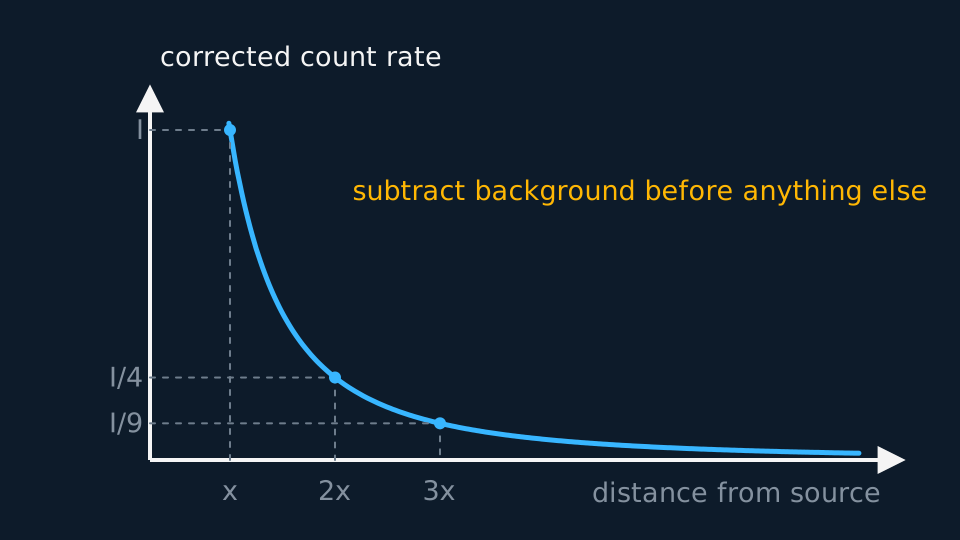
Required practical 12 tests the law with a gamma source, a detector and a metre rule. Measure the count rate at a series of distances, and subtract the background count rate from every reading first, since the law describes the source's own photons alone. A plot of corrected count rate against 1/x2 should give a straight line through the origin, the standard straightening trick for a suspected inverse square.
WORKED EXAMPLE
Background first, law second
A gamma detector reads 500 counts per minute at 0.20 m from a source, and the background alone is 20 counts per minute. Predict the reading at 0.40 m.
Correct before you calculate. The source's own rate is 500 − 20 = 480 counts per minute.
Doubling the distance quarters the corrected rate, so 480/4 = 120.
Add the background back to predict what the meter will show, 120 + 20 = 140 counts per minute. Both background steps are needed: subtract before scaling, then add the background back for the predicted reading.
Background, risk and benefit
The background radiation you must subtract has ordinary origins. Radon gas seeping from the ground, rocks and building materials, cosmic rays, traces in food, medical procedures. Measure it with the source locked away, then remove it from every reading before any analysis begins.
Medicine uses radiation with the risks assessed. An X-ray or a gamma tracer carries a small, known risk of harm, weighed against the benefit of a diagnosis that may be life-saving. The judgement asked for is exactly that. Name the risk, name the benefit, and argue the balance for the case in front of you. A blanket verdict that radiation is safe or dangerous answers a different, easier question than the one asked.
ASSESSMENT FOCUS
- In absorption questions, name the absorber that stopped the radiation, then the radiation. Give the test, then the verdict.
- Describing a radiation means three properties, not one. Composition, mass and charge: two protons and two neutrons at 4u and +2e for an alpha, an electron at about u/1840 and −1e for β−, a positron of the same mass at +1e for β+, and a photon with no mass and no charge for gamma. Include β+: a list that stops at β− describes only one of the two beta radiations.
- Correct every count rate before you use I = k/x², taking measured minus background. Background counts do not fall with distance, so arithmetic on raw counts makes the law appear not to hold.
- Quarter and ninth are worth quoting cold. Double the distance for a quarter of the intensity, treble it for a ninth. State the factor before you reach for a calculator.
- For hazards, match the radiation to the situation. Alpha is the danger inside the body, and gamma is the one that reaches you across the room.
CHECK YOURSELF
A gamma source gives a corrected count rate of 1440 counts per minute at 0.50 m. Predict the corrected count rate at 1.50 m, and explain why the background was subtracted before either reading was used.
Show a hint
How many times further than 0.50 m is 1.50 m, and what does the square of that factor do?
Show the answer
The distance is 3 times greater, so the intensity falls by a factor of 32 = 9.
1440 / 9 = 160 counts per minute.
The inverse-square law applies to the source's own photons; background counts come from everywhere and do not fall with x, so they must be removed first.
Alpha radiation is stopped by paper or a few centimetres of air; beta is stopped by a few millimetres of aluminium; gamma is penetrating and is reduced, rather than completely stopped, by thick lead or concrete.
Double the distance from a gamma source and a quarter of the intensity remains.
Subtract the background before any count rate does any work.
Or read them with their mark schemes on the rutherford scattering and the nuclear model questions page.
WHERE TO GO NEXT
- Required practical 12: the inverse-square law for gamma radiation puts this topic in the lab, and the written papers ask about it.
CHECK YOUR PROGRESS
Rate how confident you feel with each objective for this lesson. Ratings are saved in this browser, on this device, unless you sign in.
- Identify alpha, beta and gamma from a simple absorption experiment, and give the composition, mass and charge of each, both signs of beta included.
- Match each radiation to its applications and to the hazard it presents.
- Use the inverse-square law for gamma with corrected count rates, as in required practical 12.
Open the full revision checklist to track your progress across the whole unit.